
Wasted energy in IRAQ! How this energy can be made useful, how much it will cost!
Iraq possesses some of the world’s largest proven petroleum reserves, yet it faces chronic electricity deficits. A primary driver of this paradox is the routine flaring of associated petroleum gas, burning off the natural gas that surfaces alongside crude oil production due to a lack of processing infrastructure and gas-gathering networks.
Capturing and monetizing this flare gas for domestic power generation represents a transformative economic, industrial, and environmental opportunity for Iraq.
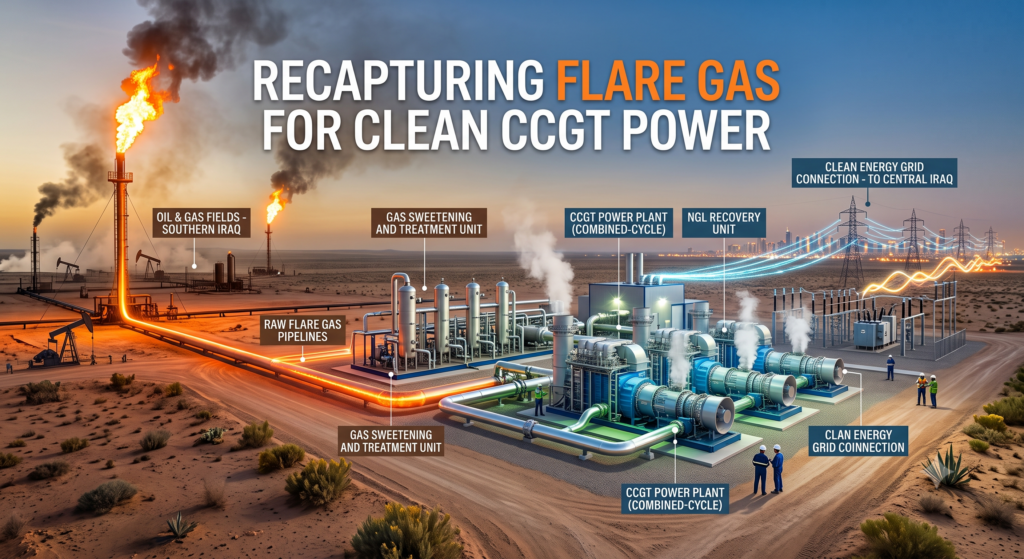
1. Magnitude of Gas Flaring in Iraq: Total Volumes & Wasted Potential
Total Flaring Volumes
Iraq ranks third globally in gas flaring volumes, behind only Russia and Iran.
- Annual Flared Volume: Iraq flares approximately 17.5 to 18.0 billion cubic meters (BCM) of associated gas per year (roughly 1.7 to 1.8 billion standard cubic feet per day [BSCFD]).
- Methane & Venting Loss: In addition to flared volumes, unburned methane leaks and routine venting contribute an additional 3.0 to 3.3 BCM annually.
- Economic Value Lost: Burning this resource results in a direct loss of $2.5 billion to $3.5 billion annually in primary energy value.
Power Generation Potential
Natural gas yields roughly 170 megawatt-hours (MWh) per million standard cubic feet (MMSCF) when combusted in high-efficiency combined-cycle power plants, or about 120 MWh in open-cycle/engine configurations.

- Gross Theoretical Capacity: 1.7 BSCFD of raw associated gas yields an estimated 8,000 MW to 9,500 MW of continuous baseline electrical output.
- Grid Context: Iraq’s total national grid demand reaches 32,000 to 35,000 MW during peak summer months, against an available grid supply of only 22,000 to 24,000 MW. Fully capturing and burning flare gas would cover 80% to 90% of Iraq’s power generation deficit, virtually eliminating reliance on imported gas and liquid fuels.
2. Location-Wide Flare Gas Distribution in Iraq
Flare gas generation in Iraq is geographically concentrated in southern oil fields, with secondary clusters in the north and central regions.
IRAQ FLARE GAS DISTRIBUTION
| Northern Basin | Central Fields | Southern Basin |
| ~10-15% Total Volume | ~5-10% Total Volume | ~75-80% Total Volume |
| Kirkuk (Baba, Avanah) | Ahdeb & Badra | Basra (Rumaila, WQ1/2 Majnoon, Ratawi) |
| Bai Hassan & Khabbaz | Mansuriya (Non-Assoc.) | Missan (Halfaya, Buzurgan) |
| Jambur | East Baghdad | Dhi Qar (Nassiriya, Gharraf) |
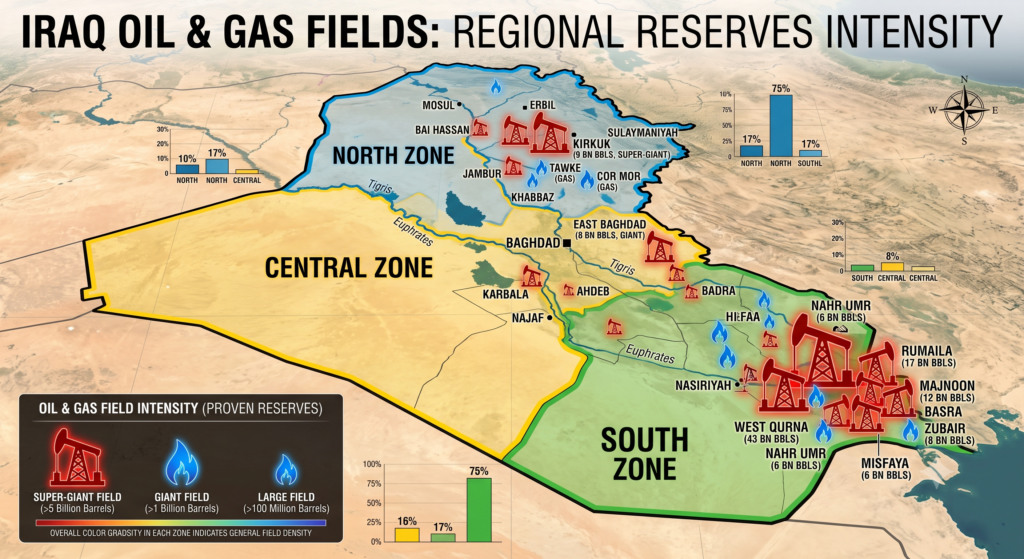
A. Southern Basin (Basra, Missan, Dhi Qar): ~75-80% of Flaring
The massive giant and super-giant oilfields in southern Iraq account for the vast majority of flared gas:
- Basra Governorate (~1.1–1.3 BSCFD flared):
- Rumaila (North & South): The world’s 3rd largest oilfield; flares roughly 400-500 MMSCFD.
- West Qurna 1 & West Qurna 2: Flares approximately 250-350 MMSCFD.
- Majnoon Field: Flares around 150-200 MMSCFD.
- Zubair, Ratawi, & Nahr Bin Umar: Account for 200-250 MMSCFD.
- Missan Governorate (~200-250 MMSCFD flared):
- Halfaya Oilfield: Flaring recently reduced by CNPC’s gas processing plant, but residual flaring remains.
- Missan Oil Fields (Buzurgan, Abu Ghraib, Fakka): Flare roughly 120-150 MMSCFD.
- Dhi Qar Governorate (~150-180 MMSCFD flared):
- Nassiriya & Gharraf Fields: Account for 150+ MMSCFD, currently targeted by South Gas Company and Baker Hughes recovery initiatives.
B. Northern & Central Basin: ~15: 20% of Flaring
- Kirkuk Field Cluster (Kirkuk, Bai Hassan, Jambur, Khabbaz): Flares approximately 120-180 MMSCFD.
- Wasit & Diyala (Badra, Ahdeb): Account for 60-90 MMSCFD.
C. Kurdistan Region (KRI): ~5–10% of Flaring
- Sarqala, Tawke, Taq Taq, & Atrush Fields: Flare roughly 100-120 MMSCFD combined.
3. Options to Convert Flare Gas to Electricity
Converting raw flare gas into electricity requires matching the technology with gas composition, field lifecycle, and infrastructure constraints.
| Technology Option | Thermal Efficiency | Tolerance to Heavy Hydrocarbons & H2S/ Deployment Lead Time/ Scalability & Flexibility/Relative CAPEX ($/kW) |
| Reciprocating Gas Engines (RICE) | 42% – 48% | High (Tolerates low Methane No. 50-70) |
| Aeroderivative Gas Turbines | 37% – 42% | Moderate (Requires clean fuel gas) |
| Heavy-Duty Industrial Gas Turbines (OCGT) | 32% – 38% | High (Handles variable BTU/heavy ends) |
| Combined-Cycle Gas Turbines (CCGT) | 52% – 60% | Low (Requires strict gas conditioning) |
| Steam Turbines / Boiler Systems | 25% – 32% | Very High (Can burn untreated sour gas) |
Recommended Strategic Approach: Two-Phase Deployment
The Best, Fastest, and Most Economical Strategy: A hybrid approach using Modular Reciprocating Gas Engines (Phase 1) for quick wellhead power generation, followed by Aeroderivative/Industrial Gas Turbines (Phase 2) for midstream power generation.
- Phase 1 (Fast & Distributed): Deploy trailer-mounted Reciprocating Gas Engines (RICE) or Mobile Aeroderivative Gas Turbines (e.g., GE TM2500) directly at Gas Oil Separation Plants (GOSPs).
- Why: They require minimal site preparation, handle variable methane numbers (MN) and sour gas traces better than industrial frame turbines, and begin generating power within months.
- Phase 2 (Centralized & High-Efficiency): Construct permanent gathering pipelines feeding centralized Gas Processing Plants (GPP) that supply pipeline-quality gas to Industrial Gas Turbines operating in Combined Cycle (CCGT) for grid baseline power.
4. Waste Flare Gas Purification Steps (Wellhead to Turbine GPRS Inlet)
Raw associated flare gas contains liquid hydrocarbons, free water, acid gases H2S and CO2, and particulates that cause catastrophic turbine corrosion, erosion, and combustion instability if untreated.
Below is the step-by-step purification train required to process raw flare gas up to the inlet of a Gas Turbine Gas Pressure Reducing Station (GPRS).
Step 1: Primary Liquids Separation & Bulk Knockout
- Equipment: 3-Phase Inlet Separator & Knockout Drum (KOD).
- Function: Removes bulk liquid water, free crude oil droplets, and heavy condensates down to 10–50 microns. Prevents liquid slugging in downstream compressors.
Step 2: Gas Compression
- Equipment: Multi-stage Rotary Screw or Reciprocating Compressors.
- Function: Associated gas off low-pressure separators usually arrives at 1 to 5 bar gauge (barg). Gas turbines require fuel gas pressures between 25 and 40 barg at the GPRS inlet.
Step 3: Acid Gas Removal Unit (AGRU / Gas Sweetening)
- Equipment: Amine Absorption Column using MDEA (Methyldiethanolamine) or specialized physical solvents (Selexol), or Membrane Units for smaller flows.
- Function: Raw Iraqi flare gas contains high concentrations of Hydrogen Sulfide H2S, often 1,000–30,000 ppm) and Carbon Dioxide CO2, 2-8%).
- Target Spec: H2S < 5 to 20 ppmv (to prevent high-temperature hot corrosion on turbine blading) and CO2 < 2 – 3 Mol% (to maintain fuel heating value).
Step 4: Gas Dehydration
- Equipment: Triethylene Glycol (TEG) Dehydration System or Molecular Sieve Adsorbers.
- Function: Removes vaporized water content to prevent pipeline hydrate formation and carbonic acid creation during compression.
- Target Spec: Water dew point down to -10 Deg C to -40 Deg C at line pressure.
Step 5: Heavy Hydrocarbon & NGL Extraction (Dew Point Control)
- Equipment: Mechanical Refrigeration Unit (MRU) or Joule-Thomson (J-T) Expansion Valve with Low-Temperature Separator (LTS).
- Function: Iraqi associated gas is exceptionally “rich” in heavy end hydrocarbons (C3+ propane, butane, pentane). These heavy hydrocarbons lower the gas Methane Number (MN), cause premature auto-ignition (knocking/detonation) in engines, and generate liquid droplets in turbine combustors.
- Target Spec: Hydrocarbon Dew Point (HDP) specified at < -10 Deg C, ensuring a minimum Methane Number of > or equal to 75. Recovered NGLs are bottled as LPG or condensate, providing an additional revenue stream.
Step 6: Particulate & Fine Coalescing Filtration
- Equipment: High-efficiency Coalescing Filters and Particulate Dry Scrubbers.
- Function: Traps trace amine carryover, lubricating oil aerosols, and solid particles down to 0.3 microns with 99.98% efficiency.
Step 7: Gas Pressure Reducing Station (GPRS) & Fuel Gas Conditioning Skid
- Equipment: Dual-redundant Pressure Control Valves, Gas Metering (Ultrasonic/Orifice), Slam-Shut Safety Valves, and Electric/Steam Fuel Gas Superheaters.
- Function: Regulates pressure to precise turbine combustor requirements (e.g., 30 Plus-Minus barg) and heats the gas 20 Deg C 30 deg C above its hydrocarbon dew point to prevent condensation right before fuel manifold injection.
5. Suitable Gas Turbines and Engines for Burning Flare Gas
Not all prime movers tolerate the thermal variations and chemical trace elements inherent to flare gas. Below are the optimal equipment choices categorized by operational deployment.
A. Aeroderivative & Mobile Gas Turbines (Best for Rapid Deployment & High Efficiency)
- GE TM2500 / LM2500+G4 (Capacity: 30–35 MW per unit)
- Why Suitable: Trailer-mounted “power plant on wheels” capable of installation within days. Features flexible combustor designs capable of burning lean-treated flared gas. High open-cycle thermal efficiency (~37–39%).
- Siemens SGT-A35 / SGT-A65 (Industrial Trent) (Capacity: 30–60 MW per unit)
- Why Suitable: Superior partial-load capability, quick start-up (under 10 minutes to full load), and proven tolerance to varied gas LHV.
B. Heavy-Duty Industrial Gas Turbines (Best for Rugged Centralized Plants)
- GE Frame 6B (PG6581B) & Frame 9E (PG9171E) (Capacity: 42 MW and 126 MW)
- Why Suitable: The undisputed standard for middle-eastern industrial sites. Features heavy, robust single-shaft construction, low firing temperatures relative to modern H/J-class machines, and immense tolerance to contaminants, high ambient temperatures (>50 Deg C), and variations in fuel BTU value.
- Siemens SGT-800 (Capacity: 50-62 MW)
- Why Suitable: Excellent efficiency in combined cycle (>55 Deg C) with dry low-emission (DLE) combustors adapted for medium-BTU fuels.
C. Heavy-Duty Reciprocating Gas Engines (Best for Unconditioned/Minimally Conditioned Wellhead Gas)
- Wärtsilä 34SG / 50SG (Capacity: 4.3 MW to 18.3 MW per unit)
- Why Suitable: Spark-ignited lean-burn engines designed specifically for variable fuel quality. Can handle lower methane numbers (MN > 50) with limited pre-treatment compared to gas turbines.
- INNIO Jenbacher J620 / J624 (Capacity: 3.0 MW to 4.5 MW per unit)
- Why Suitable: Compact modular containerized skids perfect for remote field flares with capacities under 10 MMSCFD.
6. Financial & Economic Analysis
The financial metrics for capturing Iraqi flare gas for power generation are exceptionally strong due to low fuel acquisition costs (converting a wasted byproduct into energy) and high avoided costs of liquid fuel imports.
A. Capital Expenditure Breakdown (CAPEX) Basis: 100 MMSCFD Flare Capture Project
A 100 MMSCFD capture facility yields enough gas to fuel a ~500 MW Open Cycle or ~700 MW Combined Cycle power plant.
| Project Component | Estimated CAPEX ($ Millions) |
| Gas Gathering Pipelines & Compression Stations | $120M – $160M |
| Central Gas Treatment Unit (AGRU, TEG, NGL Recovery) | $180M – $240M |
| 500 MW Gas Turbine Power Plant (Open Cycle) | $450M – $550M |
| GPRS & Interconnection Substation (400 kV/132 kV) | $50M – $70M |
| EPC, Contingency, Permitting & Owner’s Costs | $100M – $130M |
| TOTAL INITIAL CAPEX | $900M – $1,150M |
B. Operational Expenditure (OPEX)
- O&M Power Plant: ~$0.008 – $0.012 per kWh.
- O&M Gas Processing & Lines: ~$0.25 – $0.40 per MMBtu processed.
- Levelized Cost of Electricity (LCOE): $0.032 to $0.042 per kWh (compared to $0.09–$0.14/kWh when generating power with imported diesel or heavy fuel oil).
C. Annual Financial Return & Payback Summary
Assuming a baseline electricity sale value of $0.07 per kWh to the grid/industrial off-takers and NGL/LPG recovery revenue:
- Annual Power Generated (500 MW @ 85% Capacity Factor): ~3.72 Billion kWh / year.
- Electricity Revenue / Avoided Import Value: ~$260 Million / year.
- Value of Recovered NGL/LPG (Propane/Butane): ~$60 Million / year.
- Total Gross Annual Benefits: ~$320 Million / year.
- Net Operating Income (after OPEX): ~$270 Million / year.
- Simple Payback Period: 3.3 to 4.2 Years.
D. Carbon Offsets & Environmental Revenues
Capturing 100 MMSCFD of flared gas reduces direct CO2 and uncombusted methane emissions by approximately 3.5 to 4.5 million metric tons of CO2 equivalent (tCO2 e) per year.
- At carbon credit pricing under Article 6 of the Paris Agreement ($10-$20/ton), this yields an additional $35M–$90M annually in carbon finance credits.
Strategic Summary & Key Recommendations
To eliminate routine flaring and solve Iraq’s electricity deficit:
- Prioritize Deployment in Basra: Over 70% of flare gas resides in three southern fields (Rumaila, West Qurna, Majnoon). Initial efforts yield the highest returns here.
- Standardize Gas Processing Train Skids: Utilize pre-fabricated modular Amine/Dehydration skids to bypass traditional multi-year civil construction delays.
- Deploy Hybrid Prime Movers: Use modular Reciprocating Gas Engines (Wärtsilä/Jenbacher) or mobile GE TM2500 turbines for immediate flare mitigation (<12 months), while engineering permanent industrial CCGT facilities (GE Frame 9E / Siemens SGT-800) for long-term power stability.
Note: these values and assumption are taken from various online resources and through AI tools, and are provided for reference only. Admin
Sources:
Sources and methodology
This article draws on satellite-derived flaring estimates, official energy statistics, and company disclosures concerning Iraqi associated-gas recovery projects. Engineering and financial values are preliminary screening estimates prepared by the author; they are not project quotations, feasibility-study results or investment advice.
- World Bank – 2026 Global Gas Flaring Tracker Report Latest available global assessment of gas flaring, covering 2025 volumes, country rankings, flare locations and global emissions.
- World Bank – Global Gas Flaring Data Provides downloadable satellite-derived data by country and flare location. Use this dataset to support Iraq’s national volume and any geographic or field-level allocation.
- World Bank – 2025 Global Gas Flaring Tracker Report Use only if the article specifically reports 2024 flaring. Do not combine its figures with 2025 figures without identifying both years.
- IEA – Methane Tracker Data Explorer Appropriate source for Iraq’s estimated oil-and-gas methane emissions, abatement opportunities and methodological assumptions. Methane estimates should not be represented as an unsupported volume of lost natural gas.
- U.S. EIA – Iraq Country Analysis Brief, 2025 Supports Iraq’s petroleum and natural-gas balance, electricity system, Iranian gas and electricity imports, gas-processing constraints and flaring-reduction policy.
- Basrah Gas Company – Gas Gathering and Processing Confirms that BGC gathers and processes associated gas from Rumaila, West Qurna 1 and Zubair, producing dry gas, LPG and condensate.
- Basrah Gas Company – Compressor Stations and production growth Reports that BGC captures more than 60% of associated gas from its three designated fields and increased production from approximately 250 to 900 MMscf/d.
- Basrah Gas Company – Pipeline and production overview Reports approximately 950 MMscf/d of production and an estimated power-equivalent contribution of around 3.5 GW. Treat this as a company-reported conversion.
- Baker Hughes – Nassiriya and Al-Gharraf flare-gas recovery project Confirms a project designed to recover approximately 200 MMscf/d of dry gas from the Nassiriya and Al-Gharraf fields.
- Baker Hughes – Halfaya gas-flaring reduction collaboration Supports the discussion of modular gas-processing work at Halfaya and Baker Hughes’ existing activities in Dhi Qar.
- Baker Hughes – Bin Umar flare-reduction agreement Describes a proposed project expected to recover up to 300 MMscf/d. Make clear that this is expected capacity, not current production.
- TotalEnergies – Gas Growth Integrated Project Official source for the GGIP’s gas-recovery, solar, water-treatment and energy-independence objectives.
- TotalEnergies – Early Gas Treatment Unit, 2025 Provides a useful real-project cost benchmark: approximately $250 million for an early treatment unit designed to process 50 MMscf/d of previously flared gas. Its scope should be compared carefully with the article’s estimates.
- Iraq’s Nationally Determined Contribution – IEA policy summary Supports Iraq’s stated policies on flaring reduction, methane monitoring, leak detection, fuel switching and renewable-energy development.

Nawaz Ali Lakho is a power-generation professional and project-management consultant with more than 33 years of experience across thermal, nuclear, gas-turbine, steam-turbine, and combined-cycle power plants. His career encompasses plant operations, maintenance, commissioning, troubleshooting, asset management, and the leadership of multidisciplinary teams of more than 200 personnel.
His hands-on experience includes GE Frame 9E and 6FA and Alstom GT13DM gas turbines; Mitsubishi, GE, and Fuji steam turbines; heat-recovery steam generators; supercritical boilers; and major plant-control platforms from GE, ABB, Emerson, and Siemens. He has participated in cold and hot commissioning, major overhauls, hot-gas-path inspections, and combustion inspections at power facilities ranging from 150 MW to 586 MW.
At Global Power News, Nawaz shares field-informed O&M case studies, technical guidance, equipment insights, and analysis of power systems and energy infrastructure. Connect with him on LinkedIn.
International Experience: Have worked around the world specially, Pakistan, Iraq, Saudi Arabia, UAE, Angola, England and Nigeria.
Disclaimer: Articles are developed using internet research, professional field experience, and AI assistance. While every effort is made to ensure accuracy, the content may contain estimates, projections, or assumptions. The author assumes no liability for technical or computational discrepancies.