Powering Central Africa: A Deep Dive into the CAPP Network and the Grand Inga Megaproject
The Central African Power Pool (CAPP): known in French as the Pool Énergétique de l’Afrique Centrale (PEAC), was established in 2003 under the auspices of the Economic Community of Central African States (ECCAS). Headquartered in Brazzaville, Republic of the Congo, CAPP was created to integrate national electricity grids, promote cross-border energy trading, and unlock Central Africa’s vast hydroelectric potential.
1. Member Countries
CAPP comprises 10 core member states spanning Central Africa, represented by their respective national ministries of energy and state utilities:
- Angola (Rede Nacional de Transporte de Electricidade – RNT)
- Burundi (REGIDESO)
- Cameroon (ENEO Cameroon)
- Central African Republic (CAR) (ENERCA)
- Chad (Société Nationale d’Électricité – SNE)
- Democratic Republic of the Congo (DRC) (Société Nationale d’Électricité – SNEL)
- Republic of the Congo (Société Nationale d’Électricité – SNE / E2C)
- Equatorial Guinea (SEGESA)
- Gabon (Société d’Énergie et d’Eau du Gabon – SEEG)
- São Tomé and Príncipe (EMAE)
(Note: Rwanda maintains strategic ties with CAPP through shared Great Lakes institutions like SINELAC, though its primary power pool alignment is with the Eastern Africa Power Pool).
2. Physical Interconnections & Infrastructure
Historically, Central Africa operated as an isolated cluster of national grids. CAPP’s Master Plan structures physical connectivity across three primary corridors and high-voltage Priority Integration Projects (PIPs):
- Northern Corridor (Cameroon–Chad–CAR Link): A high-voltage transmission line (225 kV) connects southern hydro plants in Cameroon to N’Djamena, Chad, providing base-load power to a grid historically reliant on expensive diesel. Interconnections extending into CAR support energy delivery around Bangui.
- Central–Southern Corridor (DRC–Congo–Angola Link): The high-voltage links across the Congo River connect the Inga hydroelectric complex in DRC to Brazzaville and Pointe-Noire in the Republic of the Congo. In the south, the Inga–Cabinda line links DRC directly to northern Angola.
- Great Lakes Grid (DRC–Burundi Axis): Connected via the shared multi-national Ruzizi hydroelectric cascade (Ruzizi I, II, and the ongoing Ruzizi III project), linking eastern DRC with Burundi and Rwanda.
- Equatorial / Coastal Links: Cross-border distribution lines facilitate localized power transfers between Gabon (Grand Poubara hydro) and Equatorial Guinea (Mongomo region).
- Island State Exception: As an island nation, São Tomé and Príncipe cannot be physically linked via overhead HVAC/HVDC cables. Its participation is institutional, benefiting from joint procurement, regional planning, and technical standardization.
3. Country-by-Country Network Utilization
Each member nation engages with the CAPP network according to its supply strengths or generation deficits:
| Country | Primary Role | How It Utilizes the CAPP Network |
| DRC | Anchor Exporter | Leverages the Congo River’s Inga I & II dams to export baseload hydro power to Republic of the Congo, Angola, and the Great Lakes region. |
| Rep. of Congo | Transit Hub & Trader | Imports power from DRC during peak demand while utilizing domestic gas-fired generation (Pointe-Noire) to trade power back into regional border zones. |
| Cameroon | Northern Hub Exporter | Uses Sanaga River hydro capacity (Song Loulou, Edéa, Nachtigal) to export stable electricity to Chad via cross-border interconnections. |
| Chad | Importer & Beneficiary | Uses imported Cameroonian hydro electricity to displace costly local thermal/diesel generation in N’Djamena, reducing national generation costs. |
| Burundi | Joint Off-taker | Relies on CAPP’s Great Lakes infrastructure to draw power from shared tri-national hydro projects along the Ruzizi River. |
| CAR | Importer / Stabilizer | Off-takes power from regional interconnections to stabilize Bangui’s strained grid and complement local output from the Boali hydro plant. |
| Angola | Dual-Pool Bridge | Connects northern provinces (Cabinda) to DRC’s grid; serves as a strategic geographic link bridging CAPP with the Southern African Power Pool (SAPP). |
| Gabon | Localized Exporter | Uses surplus hydro output from stations like Grand Poubara to supply frontier towns in Equatorial Guinea. |
| Eq. Guinea | Local Trader | Utilizes domestic gas-to-power capacity (Bioko Island / Rio Muni) and imports hydro along its southern border with Gabon. |
| São Tomé & Príncipe | Institutional Member | Uses CAPP frameworks for technical assistance, capacity building, and regional renewable project financing. |
4. Energy Resources & Opportunities for Enhancement
Current Resource Mix
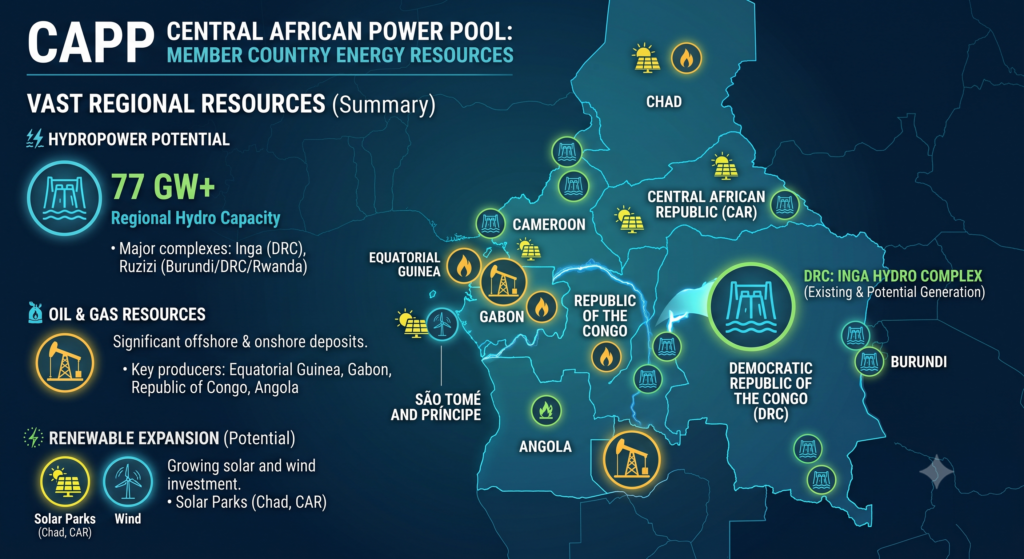
- Hydroelectric Power (~80%+ Potential): The backbone of CAPP. The Congo River Basin alone holds an estimated 100+ GW of hydro potential, with Grand Inga representing up to 42 GW of potential capacity.
- Natural Gas: Widely used in coastal member states (Republic of the Congo, Equatorial Guinea, Gabon) for gas-fired thermal plants that supply base-load and peak power.
- Solar & Biomass: Widely available across northern savanna zones (Chad, CAR) but historically underutilized at utility scale.
Key Areas for Network Enhancement
- Transition from Bilateral Deals to a Spot Market: Most CAPP trade currently relies on fixed bilateral Power Purchase Agreements (PPAs). Transitioning to an automated Day-Ahead Market (similar to SAPP) will optimize pricing.
- Developing Grand Inga & Ruzizi III: Completing major hydro generation projects will provide cheap, renewable base-load energy across Central and Southern Africa.
- Grid Harmonization via CORREAC: Expanding the mandate of the Regional Electricity Regulation Commission of Central Africa (CORREAC) will harmonize grid codes, wheeling tariffs, and third-party transmission access.
- Integrating Utility-Scale Solar: Pairing northern solar parks in Chad and CAR with central hydro reservoirs can create a balanced, seasonal energy mix.
5. Non-Member Dynamics & Regional Integration
Neighboring non-member countries include Nigeria, Niger, Sudan, South Sudan, Uganda, Tanzania, and Zambia.
Benefits for Non-Member Nations
- Access to Low-Cost Hydro Baseload: Non-members in West and East Africa (such as industrial hubs in Nigeria or East Africa) can import low-cost electricity from Central Africa’s hydro resources.
- Grid Stabilization: Hydro reservoirs in the Congo Basin provide quick-response load balancing, helping neighboring power pools integrate variable solar and wind energy.
Benefits for CAPP Member States
- Revenue Generation: Exporting electricity to high-demand markets in West, East, and Southern Africa generates substantial foreign exchange for CAPP exporters like DRC and Cameroon.
- Inter-Pool Interconnection: Linking CAPP with the West African Power Pool (WAPP), Eastern Africa Power Pool (EAPP), and Southern African Power Pool (SAPP) builds a resilient, continent-wide transmission architecture (the African Single Electricity Market).
Sources:
This article draws on publications from the World Bank, International Renewable Energy Agency, African Development Bank, African Union Development Agency–NEPAD, the Government of the Democratic Republic of the Congo and regional power-sector institutions. Grand Inga and Inga 3 remain under development; capacities, costs and schedules should therefore be identified as estimates or proposed configurations.
- IRENA – Planning and Prospects for Renewable Power: Central Africa, January 2025 The strongest general source for the article. It covers the Central African power-sector landscape, CAPP cooperation, electricity access, regional demand, renewable-resource potential, interconnection and long-term expansion scenarios.
- Central Africa Power Pool institutional profile – Africa–EU Energy Partnership Supports CAPP’s institutional role, its regional integration objective and the goal of facilitating electricity trade between participating countries.
- World Bank – Inga 3 Development Program: Questions and Answers Explains the current World Bank program, its phased structure, institutional-development activities, preparatory studies and relationship to the proposed Inga 3 project.
- World Bank – Inga 3 Development Program approval, June 3, 2025 Confirms the initial $250 million phase, the broader $1 billion multiphase envelope and planned benefits for approximately 100 communities representing 1.2 million people near Inga.
- World Bank – Inga 3 Development Program Chair Summary Primary financing record confirming the $1 billion program envelope and the composition of its initial $250 million phase.
- World Bank – Inga 3 Implementation Status and Results Report Shows that technical and financial options, stakeholder validation and environmental and social studies remain part of the preparation process. This source is important when describing the project’s present status.
- World Bank – DRC Country Economic Memorandum/Inga assessment Estimates the Inga site’s total generation potential at approximately 42 GW and explains its possible national and regional economic significance.
- Government of the DRC, Ministry of Planning – Grand Inga Official Congolese government source identifying approximately 42,000 MW of potential and describing project governance, preparatory milestones, concession arrangements and financing requirements.
- AUDA-NEPAD – Grand Inga Hydropower Project Describes Grand Inga as an Agenda 2063 flagship initiative with proposed installed capacity exceeding 42,000 MW. It also identifies financing, coordination and transmission-route challenges.
- African Development Bank – Inga Site Development and Electricity Access Support Supports AfDB’s role in preparing Inga 3, developing the Inga site and improving electricity access in the DRC and neighboring regions.
- African Development Bank – Inga 3 Development discussion Provides historical context for the earlier proposed 4,800 MW Inga 3 configuration. It should not be presented as proof that this remains the final design.
- African Development Bank – Inga hydropower stations and Kinshasa network rehabilitation
Provides background on the existing Inga generating units, rehabilitation requirements, transmission and Kinshasa’s distribution network.

Nawaz Ali Lakho is a power-generation professional and project-management consultant with more than 33 years of experience across thermal, nuclear, gas-turbine, steam-turbine, and combined-cycle power plants. His career encompasses plant operations, maintenance, commissioning, troubleshooting, asset management, and the leadership of multidisciplinary teams of more than 200 personnel.
His hands-on experience includes GE Frame 9E and 6FA and Alstom GT13DM gas turbines; Mitsubishi, GE, and Fuji steam turbines; heat-recovery steam generators; supercritical boilers; and major plant-control platforms from GE, ABB, Emerson, and Siemens. He has participated in cold and hot commissioning, major overhauls, hot-gas-path inspections, and combustion inspections at power facilities ranging from 150 MW to 586 MW.
At Global Power News, Nawaz shares field-informed O&M case studies, technical guidance, equipment insights, and analysis of power systems and energy infrastructure. Connect with him on LinkedIn.
International Experience: Have worked around the world specially, Pakistan, Iraq, Saudi Arabia, UAE, Angola, England and Nigeria.
Disclaimer: Articles are developed using internet research, professional field experience, and AI assistance. While every effort is made to ensure accuracy, the content may contain estimates, projections, or assumptions. The author assumes no liability for technical or computational discrepancies.