
The Landscape of Power Generation in Pakistan: A Comprehensive Overview
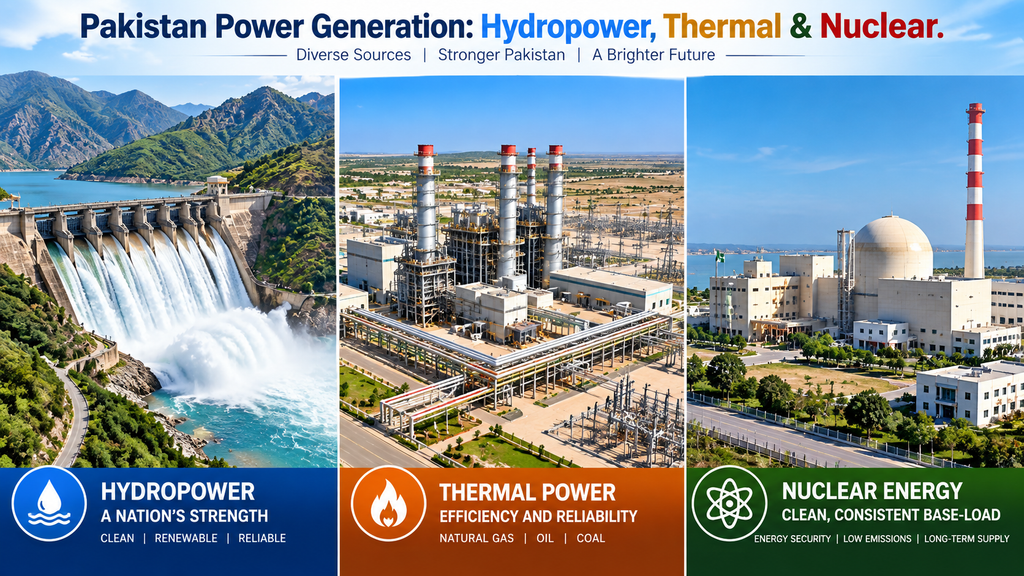
The power sector in Pakistan is a complex network of public, semi-government, and private entities. Over the past few decades, the country’s generation landscape has transformed significantly shifting from a hydro-dominant system in the early decades to a heavy reliance on fossil fuels, and now progressively moving toward local Thar coal, nuclear expansion, and a massive boom in distributed renewable energy.
According to the Pakistan Economic Survey, the total installed grid-connected generation capacity stands at 49,651 MW. When examining the structural breakdown, Pakistan’s power infrastructure is divided across several distinct administrative and operational categories:
- WAPDA (Water and Power Development Authority): Retains ownership of the country’s major hydroelectric assets.
- GENCOs (Government-Owned Generation Companies): Public sector thermal power plants managed under corporate corporate structures.
- IPPs (Independent Power Producers): Private sector generation projects operating under Power Purchase Agreements (PPAs) with the state.
- PAEC (Pakistan Atomic Energy Commission): The state organ managing all base-load nuclear power facilities.
- Provincial and Semi-Government Projects: Power plants initiated by provincial governments (such as the Government of Punjab or Government of Sindh) or public-private joint ventures.
1. WAPDA Owned (Hydroelectric Power Infrastructure)
Hydroelectric power forms the backbone of Pakistan’s clean base-load and peak generation. While WAPDA historically managed both thermal and hydro assets, it now exclusively oversees major domestic hydroelectric reservoirs and major run-of-the-river projects.
| Power Station Name | Location / Province | Installed Capacity (MW) | Type / Status |
| Tarbela Dam (Units 1–14) | Haripur, KP | 3,478 | Reservoir / Operational |
| Tarbela 4th Extension | Haripur, KP | 1,410 | Reservoir / Operational |
| Mangla Dam | Mirpur, AJ&K | 1,000 | Reservoir / Operational |
| Ghazi-Barotha | Attock / Swabi, Punjab/KP | 1,450 | Run-of-the-river / Operational |
| Neelum–Jhelum | Muzaffarabad, AJ&K | 969 | Run-of-the-river / Operational |
| Warsak Dam | Peshawar, KP | 243 | Run-of-the-river / Operational |
| Chashma Barrage Hydro | Mianwali, Punjab | 184 | Run-of-the-river / Operational |
| Dargai & Malakand | Malakand, KP | 42 | Run-of-the-river / Operational |
| Shadiwal & Chichoki Mallian | Gujrat / Sheikhupura, Punjab | 21 | Canal Fall / Operational |
| Dasu Hydropower (Stage-I) | Kohistan, KP | 2,160 | Under Construction |
| Diamer-Basha Dam | Chilas, Gilgit-Baltistan | 4,500 | Under Construction |
| Tarbela 5th Extension | Haripur, KP | 1,530 | Under Construction |
2. Public Sector Thermal (GENCOs)
In the late 1990s, WAPDA’s thermal assets were unbundled into corporatized, state-owned Corporate Generation Companies (GENCOs). These plants primarily utilize natural gas, residual furnace oil (RFO), and high-speed diesel (HSD) for generation.
Jamshoro Power Company Limited (GENCO-I)
- TPS Jamshoro (Units 1-4): Jamshoro, Sindh 880 MW (RFO / Natural Gas)
- Jamshoro Supercritical Coal Plant (Unit 1): Jamshoro, Sindh 660 MW (Lignite/Imported Coal blended)
Central Power Generation Company Limited (GENCO-II)
- TPS Guddu (Old Units & Combined Cycle): Kashmore, Sindh 1,650 MW (Natural Gas / HSD)
- Guddu 747 MW CCPP (747 MW): Kashmore, Sindh 747 MW (Natural Gas)
Northern Power Generation Company Limited (GENCO-III)
- TPS Muzaffargarh: Muzaffargarh, Punjab 1,350 MW (RFO / Natural Gas)
- Nandipur Thermal Power Plant: Gujranwala, Punjab 567 MW (Gas / Tri-fuel capability)
- Faisalabad Gas Turbine Power Station: Faisalabad, Punjab 144 MW (Natural Gas / HSD)
Lakhra Power Generation Company Limited (GENCO-IV)
- Lakhra Coal Power Plant: Jamshoro, Sindh 150 MW (Fluidized Bed Combustion – Local Coal, currently undergoing structural evaluation/partial closure).
3. Semi-Government & Public Sector (Provincial & Federal Enterprises)
To rapidly inject highly efficient thermal capacity into the grid and mitigate structural shortfalls, both federal and provincial governments established state-funded, corporatized power utilities. These run on Re-gasified Liquefied Natural Gas (RLNG) utilizing high-efficiency combined cycle gas turbines (CCGT).
| Power Plant Name | Managing Entity / Ownership | Location | Capacity (MW) | Fuel Type |
| Haveli Bahadur Shah | National Power Parks Management Company (NPPMCL) | Jhang, Punjab | 1,230 | RLNG / Gas |
| Balloki Power Plant | National Power Parks Management Company (NPPMCL) | Kasur, Punjab | 1,223 | RLNG / Gas |
| Bhikki Power Plant | Quaid-e-Azam Thermal Power Ltd (Govt. of Punjab) | Sheikhupura, Punjab | 1,180 | RLNG / Gas |
| Punjab Thermal (PTPL) | Punjab Thermal Power Instruments Ltd (Govt. of Punjab) | Jhang, Punjab | 1,263 | RLNG / Gas |
| Quaid-e-Azam Solar Park | Quaid-e-Azam Solar Power (Pvt) Ltd (Govt. of Punjab) | Bahawalpur, Punjab | 400 | Solar PV |
4. Nuclear Power Infrastructure (PAEC Owned)
Nuclear power serves as an increasingly vital component of Pakistan’s clean base-load generation mix, operated entirely by the Pakistan Atomic Energy Commission (PAEC) under international safety safeguards.
- Chashma Nuclear Power Complex (CHASNUPP 1-4): Mianwali, Punjab 1,330 MW (4 Units: 325MW, 325MW, 340MW, 340MW PWR)
- Karachi Nuclear Power Complex (KANUPP 2 & 3): Karachi, Sindh 2,290 MW (2 Units: 1,145 MW each, Generation-III Hualong One PWR design)
- Chashma-5 (CHASNUPP-5): Mianwali, Punjab 1,200 MW (Under Construction)
5. Independent Power Producers (IPPs) Private Sector
Major Coal-Fired IPPs (CPEC & Local Thar Lignite)
- Sahiwal Coal Power Plant: Sahiwal, Punjab (Huaneng Shandong Ruyi) 1,320 MW (Imported Bituminous Coal)
- Port Qasim Coal Power Plant: Karachi, Sindh (PowerChina / Al-Mirqab) 1,320 MW (Imported Bituminous)
- China Power Hub Generation (CPHGC): Hub, Balochistan 1,320 MW (Imported Bituminous / Blended)
- Engro Powergen Thar: Tharparkar, Sindh 660 MW (Local Thar Lignite Block II)
- Thar Coal Block-1 Power Plant: Tharparkar, Sindh (Shanghai Electric) 1,320 MW (Local Thar Lignite)
- Lucky Electric Power Company: Bin Qasim, Sindh 660 MW (Thar Lignite / Blended)
- Thar Energy Limited (TEL): Tharparkar, Sindh (HUBCO) 330 MW (Local Thar Lignite)
- ThalNova Power Thar: Tharparkar, Sindh 330 MW (Local Thar Lignite)
Major Gas & RFO-Fired Thermal IPPs
- Kot Addu Power Company (KAPCO): Kot Addu, Punjab 1,600 MW (Gas / Multi-fuel CCGT)
- Hub Power Plant (HUBCO Thermal): Hub, Balochistan 1,292 MW (RFO)
- Uch-I & Uch-II Power Plants: Dera Murad Jamali, Balochistan 994 MW (Low-BTU Indigenous Gas)
- Rousch Power Plant: Khanewal, Punjab 450 MW (Natural Gas / RLNG)
- Lalpir Power Plant: Muzaffargarh, Punjab 362 MW (RFO)
- PakGen Power Plant: Muzaffargarh, Punjab 365 MW (RFO)
- Fauji Kabirwala Power Company: Kabirwala, Punjab 157 MW (Gas)
- TNB Liberty Power: Daharki, Sindh 235 MW (Gas)
- Engro Powergen Qadirpur: Ghotki, Sindh 227 MW (Permit/Flared Gas)
- Foundation Power Company: Daharki, Sindh 179 MW (Gas)
- Halmore Power Generation: Bhikki, Punjab 225 MW (Gas/RLNG CCGT)
- Orient Power: Balloki, Punjab 225 MW (Gas/RLNG)
- Saif Power Limited: Sahiwal, Punjab 225 MW (Gas/RLNG)
- Sapphire Electric Company: Muridke, Punjab 235 MW (Gas/RLNG)
- Attock Gen Limited: Morgah, Rawalpindi, Punjab 165 MW (RFO/Heavy Fuel Oil)
- Atlas Power Plant: Sheikhupura, Punjab 224 MW (RFO)
- Nishat Power & Nishat Chunian Power: Kasur, Punjab 404 MW (2 Plants of 202 MW each, RFO)
- Hubco Narowal Energy: Narowal, Punjab 214 MW (RFO Engine-based)
Private Hydropower IPPs
- Karot Hydropower Project: Jhelum River, Rawalpindi/AJ&K (CPEC / China Three Gorges) 720 MW
- Patrind Hydropower Plant: Kunhar River, AJ&K 150 MW
- Mira Power (Gulpur Hydro): Poonch River, AJ&K 102 MW
- New Bong Escape Hydro: Mirpur, AJ&K (Laraib Energy) 84 MW
6. K-Electric (KE) Portfolio (Privatized Vertically Integrated Utility)
Unlike the rest of the country, which operates under unbundled distribution companies (DISCOs) supplied by the National Transmission & Dispatch Company (NTDC), Karachi and its surrounding industrial hubs are supplied by K-Electric, a privately managed, vertically integrated power utility that commands its own generation assets alongside imports from the national grid.
- Bin Qasim Power Station III (BQPS-III): Karachi, Sindh 942 MW (High-efficiency RLNG CCGT Configuration)
- Bin Qasim Power Station II (BQPS-II): Karachi, Sindh 572 MW (Gas / RFO)
- Bin Qasim Power Station I (BQPS-I): Karachi, Sindh 840 MW (Older Multi-fuel units, undergoing structural decommissioning/re-evaluation)
- Korangi Combined Cycle Plant (KCCPP): Karachi, Sindh 248 MW (Gas)
- Korangi & SITE Gas Turbine Power Stations: Karachi, Sindh 214 MW (2 Plants of 107 MW each)
7. Renewable Energy Infrastructure (Wind, Solar, & Bagasse)
Wind and solar installations are predominantly situated in southern commercial clusters, particularly the Jhimpir-Gharo wind corridor in Sindh and high-irradiance zones in Punjab and Balochistan.
Wind Power IPPs (Jhimpir / Gharo Corridor, Sindh)
Pakistan hosts over 35 operational wind power farms with individual capacities ranging between 30 MW and 50 MW, yielding a combined grid contribution exceeding 1,800 MW. Key commercial projects include:
- FFF Power, ACT2 Wind, Artistic Wind Power, Lakeside Energy, Din Energy, Master Green Energy, and Tricon Boston Consulting units.
Grid-Scale Solar IPPs
Beyond the state-owned Quaid-e-Azam Solar Park, commercial solar farms contribute directly to regional substations:
- Zorlu Enerji Solar (100 MW), Atlas Solar (100 MW), Gharo Solar (50 MW), and AJ Power (12 MW).
Biomass / Bagasse Cogeneration (Sugar Mills)
Regulated under NEPRA’s renewable frameworks, major agro-industrial sugar complexes supply high-pressure cogenerated steam power to the grid during crushing seasons, contributing roughly 350+ MW across dozens of localized generation units (e.g., JDW Sugar Mills, Al-Moiz Industries, Hamza Sugar Mills).
Summary of the Modern Generation Mix
Pakistan’s strategic policy focuses on moving away from volatile imported fuel streams (such as imported fuel oil and liquefied gas) toward domestic resource integration. The massive scaling of Thar Lignite projects, completion of strategic CPEC run-of-the-river hydro assets, and a historic boom in rooftop distributed solar generation continue to fundamentally reshape the operations of the national grid.
Sources:
Pakistan Economic Survey 2024–25 – Ministry of Finance
https://www.finance.gov.pk/survey_2425.htmlNational Electric Power Regulatory Authority (NEPRA) – State of Industry Report
https://nepra.org.pk/publications.htmNEPRA – Generation Licence Holders
https://nepra.org.pk/licensing/LicencesGeneration.phpNational Transmission & Dispatch Company (NTDC)
https://www.ntdc.com.pkPower Information Technology Company (PITC) – Pakistan Power Statistics
https://www.pitc.com.pkPrivate Power & Infrastructure Board (PPIB)
https://www.ppib.gov.pkAlternative Energy Development Board (AEDB)(now integrated into the Private Power and Infrastructure Board)
https://www.ppib.gov.pkWater and Power Development Authority (WAPDA)
https://www.wapda.gov.pkPakistan Atomic Energy Commission (PAEC)
https://www.paec.gov.pkKarachi Electric (K-Electric)
https://www.ke.com.pkNational Power Parks Management Company Limited (NPPMCL)
https://nppmcl.comJamshoro Power Company Limited (GENCO-I)
https://jpcl.com.pkCentral Power Generation Company Limited (GENCO-II)
https://cpgcl.gov.pkNorthern Power Generation Company Limited (GENCO-III)
https://www.npgcl.gov.pkLakhra Power Generation Company Limited (GENCO-IV)
https://www.lpgcl.gov.pkChina-Pakistan Economic Corridor (CPEC) Official Portal
https://cpec.gov.pkPakistan Bureau of Statistics
https://www.pbs.gov.pkInternational Energy Agency (IEA) – Pakistan
https://www.iea.orgInternational Renewable Energy Agency (IRENA) – Pakistan
https://www.irena.orgWorld Bank – Pakistan Energy Sector
https://www.worldbank.org/en/country/pakistanAsian Development Bank – Pakistan Energy
https://www.adb.org/countries/pakistan/mainWorld Bank – Pakistan Development Update
https://www.worldbank.org/en/country/pakistan/publication/pakistan-development-updateCPPA-G (Central Power Purchasing Agency)
https://www.cppa.gov.pkNational Grid Company of Pakistan (formerly NTDC system operator functions)
https://www.ntdc.com.pkEmber – Pakistan Electricity Review
https://ember-energy.orgCIGRE – International Council on Large Electric Systems
https://www.cigre.orgIEEE Power & Energy Society
https://www.ieee-pes.orgHydro Review – Pakistan Hydropower
https://www.hydroreview.comWorld Nuclear Association – Pakistan
https://world-nuclear.org/information-library/country-profiles/countries-o-s/pakistan.aspxInternational Hydropower Association
https://www.hydropower.org

Nawaz Ali Lakho is a power-generation professional and project-management consultant with more than 33 years of experience across thermal, nuclear, gas-turbine, steam-turbine, and combined-cycle power plants. His career encompasses plant operations, maintenance, commissioning, troubleshooting, asset management, and the leadership of multidisciplinary teams of more than 200 personnel.
His hands-on experience includes GE Frame 9E and 6FA and Alstom GT13DM gas turbines; Mitsubishi, GE, and Fuji steam turbines; heat-recovery steam generators; supercritical boilers; and major plant-control platforms from GE, ABB, Emerson, and Siemens. He has participated in cold and hot commissioning, major overhauls, hot-gas-path inspections, and combustion inspections at power facilities ranging from 150 MW to 586 MW.
At Global Power News, Nawaz shares field-informed O&M case studies, technical guidance, equipment insights, and analysis of power systems and energy infrastructure. Connect with him on LinkedIn.
International Experience: Have worked around the world specially, Pakistan, Iraq, Saudi Arabia, UAE, Angola, England and Nigeria.
Disclaimer: Articles are developed using internet research, professional field experience, and AI assistance. While every effort is made to ensure accuracy, the content may contain estimates, projections, or assumptions. The author assumes no liability for technical or computational discrepancies.