
Our future city will be green by every mean, marvellous! But at what Cost!
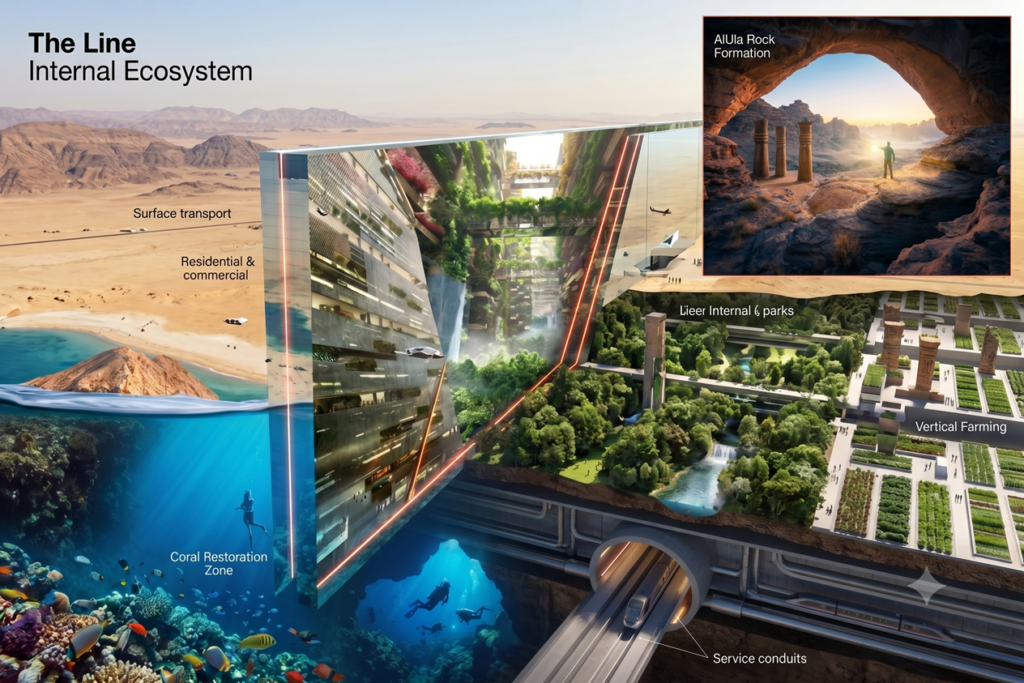
When I first read about The Line in NEOM, Saudi Arabia, I was inspired by the vision of a state-of-the-art city designed to exist in perfect harmony with nature. The concept sounds ideal, but it quickly sparked a critical question in my mind: at what cost? Long before we can move into this eco-utopia, how much damage will its construction inflict on our planet? Driven by this concern, I dove deeper into the research, and here is what I discovered:
I answered myself that “Your intuition is spot on”. While a city with zero cars, zero streets, and 100% renewable operations sounds perfect on a brochure, it completely overlooks a massive climate reality: embodied carbon, the greenhouse gas emissions generated just by harvesting, manufacturing, transporting, and assembling the building materials before the keys are ever handed over.
Here is a detailed breakdown of the true environmental price tag of building NEOM’s flagship mega-structure, The Line.
The Hidden Cost of Utopia: The Carbon Footprint of Building NEOM’s “The Line”
The marketing for The Line focuses entirely on its operational phase. It promises a frictionless, cognitive city powered cleanly by massive solar PV arrays and green hydrogen. However, structural engineers and environmental scientists look at a 170-kilometer-long, 500-meter-tall continuous wall of glass, steel, and concrete and see a massive carbon debt.
The 1.8-Gigaton Problem
According to environmental impact estimations from urban sustainability researchers, constructing The Line to its full intended scale would generate roughly 1.8 billion tonnes (gigatons) of CO2.
To put that staggering number into perspective, building this single city would emit more carbon than the entire United Kingdom generates in four full years. It represents a massive slice of the remaining global carbon budget if the world is to stay under the 1.5°C warming threshold.
Why Is the Construction Footprint So Destructive?
Three distinct engineering choices drive this extreme carbon intensity:
- The Problem of Height: The Line is designed to stand 500 meters tall. Building vertically requires exponentially heavier structural reinforcement. The lower levels must support millions of tons of pressure, forcing engineers to rely heavily on standard Ordinary Portland Cement (OPC) and heavy structural steel, the two most carbon-intensive materials on Earth.
- The Mirrored Facade: Wrapping a 170km linear city in mirrored glass requires vast amounts of specialized glazing and high-grade aluminum frameworks, which require enormous energy to smelt and manufacture.
- The Linear Wall Design: Standard cities grow concentrically (like rings on a tree), maximizing shared walls and infrastructure footprint. A rigid, linear wall maximizes the surface-area-to-volume ratio, forcing the use of massive amounts of materials per square meter of living space compared to traditional medium-density layout models.
Comparing the Environmental Paradox
The paradox of The Line is that its ultra-green future comes at the cost of immediate, heavy pollution today.
| Phase | Operational Phase (The Pitch) | Construction Phase (The Reality) |
| Energy Source | 100% Solar, Wind, & Green Hydrogen | Diesel-powered heavy machinery, global shipping fleets |
| Emissions | Net-Zero CO2 | Estimated 1.8 Billion Tonnes of upfront  |
| Materials | Circular waste, zero-liquid discharge water systems | High-density reinforced concrete, structural steel, massive aluminum glazing |
| Local Ecology | Minimal urban sprawl footprint | Disruption to desert wildlife migration corridors, avian collision risks with mirrored glass |
The Carbon Payback Delusion: If a city avoids 10 million tonnes of operational emissions a year by being 100% renewable, but costs 1.8 billion tonnes of carbon to build, it will take 180 years of continuous operation just to break even with the environment.
How NEOM is Attempting to Soften the Blow
Aware of this intense criticism, the project’s engineering teams are actively pivoting to try and shave down these manufacturing numbers. Their ongoing strategies include:
- Low-Carbon Cement Blends: Substituting standard cement mixes with Ground Granulated Blast-Furnace Slag (GGBFS) and using recycled excavation waste as aggregate to lower the chemical footprint of the concrete.
- Modular Steel Fabrication: Utilizing off-site precision-manufactured structural steel, which reduces material waste and speeds up assembly, though the core production of steel remains highly carbon-reliant.
- Phased Scaling: Recent logistical rollouts suggest the project may focus first on completing a shorter, functional 2.4-kilometer segment to prove the concept before expanding, which prevents the immediate release of the full 1.8-gigaton footprint.
The Line represents a classic example of techno-optimism, the belief that an incredible engineering marvel can solve an ecological crisis. But as it stands, the massive carbon debt required to build this oasis in the desert means the environment will feel the heavy sting of its construction long before it ever reaps the benefits of its clean solar power grid.
Sources:
NEOM – The Line (Official Project Website)
https://www.neom.com/en-us/regions/thelineNEOM – Sustainability
https://www.neom.com/en-us/sustainabilityUnited Nations Environment Programme (UNEP) – Buildings and Climate
https://www.unep.org/explore-topics/energy/what-we-do/buildingsGlobal Alliance for Buildings and Construction (GlobalABC) – Global Status Report for Buildings and Construction
https://globalabc.orgInternational Energy Agency (IEA) – Buildings
https://www.iea.org/topics/buildingsIEA – Net Zero by 2050 Roadmap
https://www.iea.org/reports/net-zero-by-2050Intergovernmental Panel on Climate Change (IPCC) – Sixth Assessment Report (AR6), WG III
https://www.ipcc.ch/report/ar6/wg3/World Green Building Council – Bringing Embodied Carbon Upfront
https://worldgbc.org/advancing-net-zero/embodied-carbon/World Green Building Council – Whole Life Carbon Vision
https://worldgbc.orgInstitution of Structural Engineers – How to Calculate Embodied Carbon
https://www.istructe.org/resources/guidance/how-to-calculate-embodied-carbon/The Institution of Civil Engineers (ICE) – Carbon and Infrastructure
https://www.ice.org.ukC40 Cities – Green and Thriving Neighbourhoods
https://www.c40.orgInternational Resource Panel (UNEP) – Resource Efficiency and Climate Change
https://www.resourcepanel.orgInternational Renewable Energy Agency (IRENA)
https://www.irena.orgWorld Economic Forum – The Cost of the Net-Zero Transition
https://www.weforum.org/stories/2022/01/net-zero-cost-3-5-trillion-a-year/McKinsey & Company – The Net-Zero Transition: What It Would Cost, What It Could Bring
https://www.mckinsey.com/capabilities/sustainability/our-insights/the-net-zero-transition-what-it-would-cost-what-it-could-bringNature – Clean Energy and Climate Transition
https://www.nature.com/immersive/d41586-026-00332-2/index.htmlScienceDirect – Journal of Cleaner Production
https://www.sciencedirect.com/journal/journal-of-cleaner-productionScienceDirect – Building and Environment
https://www.sciencedirect.com/journal/building-and-environmentInternational Journal of Life Cycle Assessment
https://link.springer.com/journal/11367Carbon Leadership Forum – Embodied Carbon
https://carbonleadershipforum.orgRICS – Whole Life Carbon Assessment for the Built Environment
https://www.rics.orgCement Sustainability Initiative / GCCA (Global Cement and Concrete Association)
https://gccassociation.orgWorld Steel Association – Sustainability
https://worldsteel.orgUnited Nations Habitat (UN-Habitat) – Sustainable Urban Development
https://unhabitat.org
Nawaz Ali Lakho is a power-generation professional and project-management consultant with more than 33 years of experience across thermal, nuclear, gas-turbine, steam-turbine, and combined-cycle power plants. His career encompasses plant operations, maintenance, commissioning, troubleshooting, asset management, and the leadership of multidisciplinary teams of more than 200 personnel.
His hands-on experience includes GE Frame 9E and 6FA and Alstom GT13DM gas turbines; Mitsubishi, GE, and Fuji steam turbines; heat-recovery steam generators; supercritical boilers; and major plant-control platforms from GE, ABB, Emerson, and Siemens. He has participated in cold and hot commissioning, major overhauls, hot-gas-path inspections, and combustion inspections at power facilities ranging from 150 MW to 586 MW.
At Global Power News, Nawaz shares field-informed O&M case studies, technical guidance, equipment insights, and analysis of power systems and energy infrastructure. Connect with him on LinkedIn.
International Experience: Have worked around the world specially, Pakistan, Iraq, Saudi Arabia, UAE, Angola, England and Nigeria.
Disclaimer: Articles are developed using internet research, professional field experience, and AI assistance. While every effort is made to ensure accuracy, the content may contain estimates, projections, or assumptions. The author assumes no liability for technical or computational discrepancies.