Turning on the Lights: The Blueprint for Africa’s Interconnected Energy Future
Despite holding some of the world’s richest energy reserves, Africa has historically grappled with deep infrastructural deficits. As of 2026, the continent stands at a critical execution crossroads. Initiatives like Mission 300 championed by the World Bank and the African Development Bank are pushing hard to bring electricity to 300 million people by 2030.
Achieving true energy security requires shifting the focus from individual nations to an integrated, continent-wide strategy. This two-part article breaks down Africa’s current energy landscapes, the massive transmission gaps, and the cross-border infrastructure designed to unite its grids.
Part 1: The Paradox of Abundance, Demand, Shortfalls, and Resources
The Scaling Challenge: Demand vs. Shortfall
Africa operates on a stark energy paradox: it possesses 60% of the world’s best solar resources, yet accounts for less than 3% of global installed solar capacity. More than 600 million people across Sub-Saharan Africa still lack access to basic electricity.
The continent’s power deficit isn’t just about domestic lighting; it is a structural barrier to economic growth. Rapid urbanization, population booms, and industrial shifts (like localized mineral processing) are driving a double surge in demand.
While heavy industrial nations like South Africa and Egypt maintain massive grids, they face distinct hurdles:
- Sub-Saharan Africa experiences chronic generation shortages and daily load-shedding, with aging assets frequently pushed past their limits.
- North Africa faces rising summer peaks driven by intense cooling demands and growing desalination needs.
To keep pace, Africa’s total electricity generation is projected to rise by over 50% by 2030, climbing from roughly 1.1 million Gigawatt-hours (GWh) to nearly 1.8 million GWh.
The Resource Mix: Africa’s Diversified Fuel Basket
The continent’s energy strategy relies on balancing diverse regional resource profiles:
- Solar and Wind: Solar is expanding faster in Africa than anywhere else, growing at over 17% annually. Plummeting module and battery prices have made localized commercial, industrial, and residential rooftop solar highly competitive, often bypassing unreliable local utility grids entirely.
- Natural Gas: Emerging gas discoveries in Mozambique, Tanzania, Senegal, and Mauritania serve as crucial transition fuels. Gas-to-power skids and combined-cycle plants provide vital baseload stability to balance variable renewable sources.
- Hydropower: Long-standing giants like Ethiopia’s Grand Ethiopian Renaissance Dam (GERD) and the DRC’s Inga cascades offer immense capacity. However, rising water scarcity such as recent prolonged droughts in Southern Africa, highlights the vulnerability of relying too heavily on hydro.
- Nuclear and Coal: South Africa continues to navigate its coal-heavy inheritance while planning grid updates. Meanwhile, Egypt is constructing the El Dabaa nuclear power plant, set to introduce 4.8 GW of reliable baseload power to the North African grid by the late 2020s.
Part 2: Binding the Continent – Power Pools and the $120 Billion Grid Gap
The Five Regional Power Pools
Africa cannot solve its power crisis through isolated generation alone. Power must move across borders. To facilitate this, the African Union coordinates five distinct regional power pools:
- Southern African Power Pool (SAPP): The most advanced and institutionalized network. SAPP features a competitive, day-ahead trading market where member utilities actively trade electricity based on real-time pricing and availability.
- West African Power Pool (WAPP): Rapidly progressing toward full, permanent synchronization. Landmark infrastructure like the CLSG Interconnector (linking Côte d’Ivoire, Liberia, Sierra Leone, and Guinea) brings power to historically isolated post-conflict zones.
- Eastern Africa Power Pool (EAPP): Dominated by East Africa’s hydro and geothermal assets, EAPP is rapidly expanding its footprint from its base in Addis Ababa.
- Comité Maghrébin de l’Électricité (COMELEC): Serving North Africa, this pool features highly advanced domestic infrastructure, though it historically favors bilateral trade and links to Europe over deep continental integration.
- Central African Power Pool (CAPP): Holds the continent’s largest theoretical clean energy potential via the Congo River basin, but faces significant infrastructure underinvestment.
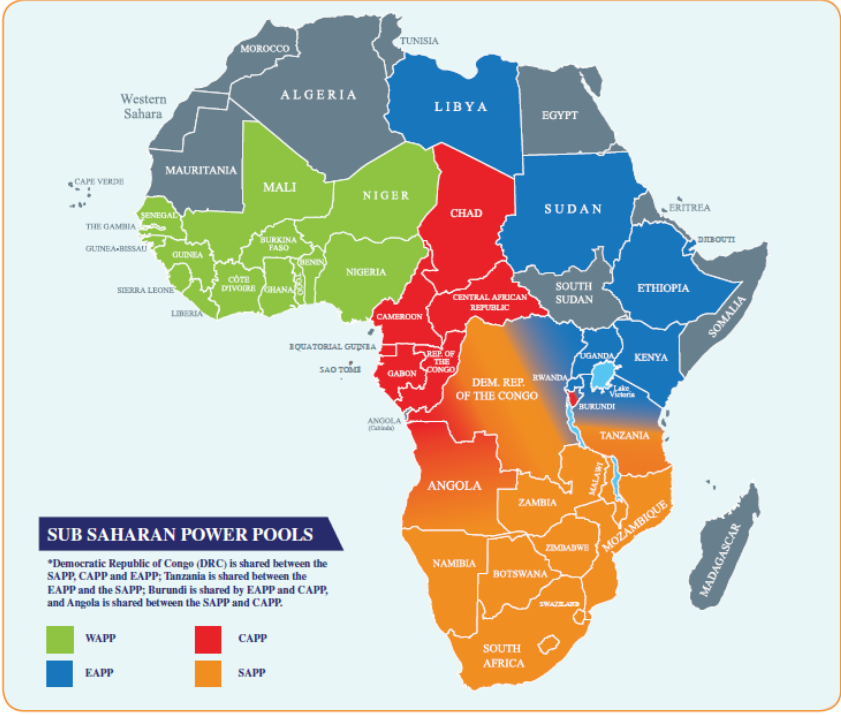
Source: Business Sweeden
The Real Bottleneck: The Transmission Gap
The most critical bottleneck in African energy isn’t a lack of power plants; it is stranded capacity. A power plant cannot help a factory if there are no high-voltage lines to carry the electricity.
Analysts estimate Africa’s transmission and distribution gap exceeds $100 to $120 billion over the next decade. Weak state utility balance sheets and frequent localized grid collapses highlight the urgent need for robust transmission networks.
Significant progress is underway to bridge these gaps through major cross-border corridors:
- The Ethiopia-Kenya-Tanzania Electricity Highway: A 2,000 MW high-voltage direct current (HVDC) link now anchoring the EAPP.
- The Zambia-Tanzania-Kenya (ZTK) Interconnector: A critical transmission corridor designed to link the EAPP directly to the SAPP, allowing power to flow seamlessly from Cairo to Cape Town.
Strategic Takeaways: How African Nations Cooperate
Cross-border interconnections unlock clear economic and operational advantages for participating countries:
- Resource Complementarity: Nations can balance out localized climate risks. When drought diminishes East African or Southern African hydro reserves, natural gas from Mozambique or solar power from North Africa can fill the shortfall.
- Capital Optimization: Instead of every nation building expensive, redundant backup generation plants, countries can invest in shared regional assets, drastically reducing the overall cost of energy.
- Attracting Private Investment: Unified power pools create larger, highly predictable energy markets. Private developers are far more likely to fund massive generation projects when they can safely export surplus power to an entire continent via transparent wheeling tariffs.
Ultimately, Africa’s energy future relies on realizing the African Single Electricity Market (AfSEM) master plan—transforming cross-border trade into a unified, continental grid.
Sources:
African Union – Programme for Infrastructure Development in Africa (PIDA)
https://www.au-pida.orgAfrican Union Development Agency (AUDA-NEPAD)
https://www.nepad.orgAfrican Development Bank – Energy Sector
https://www.afdb.org/en/topics-and-sectors/sectors/energyAfrican Development Bank – Mission 300
https://www.afdb.orgWorld Bank – Mission 300: Connecting 300 Million People to Electricity by 2030
https://www.worldbank.org/en/news/press-release/2024/04/17/new-partnership-aims-to-connect-300-million-to-electricity-by-2030International Energy Agency (IEA) – Africa Energy Outlook
https://www.iea.org/reports/africa-energy-outlookIEA – Electricity
https://www.iea.org/topics/electricityInternational Renewable Energy Agency (IRENA) – Africa
https://www.irena.org/Regions/AfricaTracking SDG7: The Energy Progress Report
https://trackingsdg7.esmap.orgUnited Nations Economic Commission for Africa (UNECA) – Energy
https://www.uneca.orgEastern Africa Power Pool (EAPP)
https://www.eappool.orgSouthern African Power Pool (SAPP)
https://www.sapp.co.zwWest African Power Pool (WAPP)
https://www.ecowapp.orgCentral African Power Pool (CAPP/PEAC)
https://www.peacpool.orgNorth African regional electricity cooperation (COMELEC)
https://www.comelec-afrique.orgCIGRE – International Council on Large Electric Systems
https://www.cigre.orgIEEE Power & Energy Society
https://www.ieee-pes.orgWorld Bank – Regional Power Trade and Electricity Market Development
https://www.worldbank.org/en/topic/energyEnergy Policy (ScienceDirect) – Electricity Market Integration in Africa
https://www.sciencedirect.com/journal/energy-policySustainability – Harmonizing the Electricity Markets in Africa
https://www.mdpi.com/2071-1050/14/17/10924The Global Grid (Chatzivasileiadis, Ernst & Andersson)
https://arxiv.org/abs/1207.4096World Bank – Mission 300 Progress and Energy Access
https://www.worldbank.org/en/news/press-release/2026/06/16/under-mission-300-a-new-way-of-doing-business-connects-over-50-million-people-to-electricity-across-africaTracking SDG7 / IEA – Global Energy Access Statistics
https://www.iea.org/news/655-million-people-still-living-without-electricity-underscore-urgent-need-to-deliver-on-universal-energy-access-targetAfrican Single Electricity Market (AfSEM) – African Union
https://au-afsem.orgProgramme for Infrastructure Development in Africa (PIDA) PAP 2
https://www.au-pida.org/pap-2
Nawaz Ali Lakho is a power-generation professional and project-management consultant with more than 33 years of experience across thermal, nuclear, gas-turbine, steam-turbine, and combined-cycle power plants. His career encompasses plant operations, maintenance, commissioning, troubleshooting, asset management, and the leadership of multidisciplinary teams of more than 200 personnel.
His hands-on experience includes GE Frame 9E and 6FA and Alstom GT13DM gas turbines; Mitsubishi, GE, and Fuji steam turbines; heat-recovery steam generators; supercritical boilers; and major plant-control platforms from GE, ABB, Emerson, and Siemens. He has participated in cold and hot commissioning, major overhauls, hot-gas-path inspections, and combustion inspections at power facilities ranging from 150 MW to 586 MW.
At Global Power News, Nawaz shares field-informed O&M case studies, technical guidance, equipment insights, and analysis of power systems and energy infrastructure. Connect with him on LinkedIn.
International Experience: Have worked around the world specially, Pakistan, Iraq, Saudi Arabia, UAE, Angola, England and Nigeria.
Disclaimer: Articles are developed using internet research, professional field experience, and AI assistance. While every effort is made to ensure accuracy, the content may contain estimates, projections, or assumptions. The author assumes no liability for technical or computational discrepancies.