
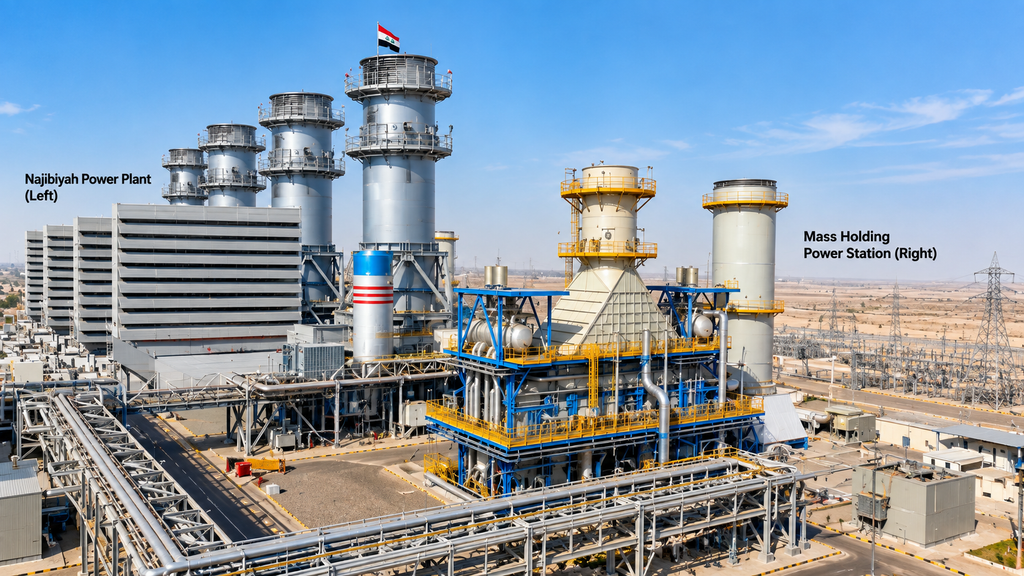
Iraq Power Infrastructure and the share of IPPs and MOE and Old and new power stations
The Iraqi power generation sector is split between assets directly owned and operated by the Ministry of Electricity (MOE) and assets developed under the Independent Power Producer (IPP) / Private Investment model (often via the National Investment Commission).
The grid faces heavy strain due to feedstock availability (natural gas shortages), rapid summer ambient heat derating, and the aging infrastructure of older steam plants. However, extensive rehabilitation and upgrade programs (such as massive fast-track service agreements with GE Vernova and Siemens) are keeping major legacy plants alive while shifting open-cycle assets to combined-cycle configuration.
1. Private Investment / IPP Power Stations1:
Private developers primarily Mass Group Holding (MGH), KAR Group, Shamara Holding, and Raban Al-Safina own and operate the most stable base-load capacities in Iraq. They are generally in Good/Operational condition and are highly prioritized for fuel allocations due to their efficiency.
| Station Name | Key Investor / Developer | Installed Capacity | Configuration & Primary Fuel | Status & Operational Condition |
| Besmaya (Baghdad) | Mass Group Holding (MGH) | ~4,500 MW | Combined-Cycle (12x GE 9F + 6x Steam) / Gas & Diesel | Running & Highly Operational. The largest plant in Iraq. Underwent extensive Advanced Gas Path (AGP) upgrades by GE Vernova in 2024–2025 to increase output and minimize fuel consumption. |
| Rumaila Shamara (Basra) | Shamara Holding Group | ~3,000 MW | Combined-Cycle (GE 9E series) / Gas & Liquid Fuel | Running / Operational. Critical base-load station for the southern grid. |
| Rumaila Northern / Shatt Al-Basra | KAR Group / KEPPT | ~3,150 MW | Combined-Cycle / Gas & Diesel | Running / Operational. Actively supplying power to the southern hub; relies on local captured gas and backup fuel. |
| Erbil Gas Power Plant | Mass Group Holding (MGH) | 1,500 MW | Combined-Cycle / Gas & Diesel | Running / Operational. High stability asset tied to the KRI and national network. |
| Sulaymaniyah (Chamchamal) | Mass Group Holding (MGH) | 1,500 MW | Combined-Cycle / Gas & Diesel | Running / Operational. Highly reliable base-load asset. |
| Khurmala (Kirkuk/Erbil) | KAR Group | ~930 MW | Combined-Cycle / Gas & Diesel | Running / Operational. Fed heavily by localized gas infrastructure. |
| Maysan Combined Cycle | Raban Al-Safina for Energy | 1,710 MW | Combined-Cycle / Gas & Diesel | Running / Operational. Newer private investment block delivering vital capacity to the eastern grid. |
| Dohuk Gas Power Station | Mass Group Holding (MGH) | 1,000 MW | Simple-Cycle / Gas & Diesel | Operational. Bounces between operational limits based on regional fuel supplies. |
2. Ministry of Electricity (MOE) Gas Turbine Plants:
The MOE owns a massive fleet of gas plants, largely built around GE Frame 9E, Alstom GT13E2, and Siemens V94.2 assets. Performance depends directly on whether they are receiving natural gas or are forced to run on heavy, dirtier liquid fuels.
| Station Name | Installed Capacity | Configuration / Main Tech | Current Condition & Fuel Constraints |
| Wassit (Zubaydiyyah) | 2,540 MW | Heavy Fuel Oil & Gas Combustion | Running / Critical. One of the largest MOE-owned stations. Heavily utilized but requires continuous heavy maintenance due to fuel oil traits. |
| Al-Anbar | 1,643 MW | Combined-Cycle | Partially Operational / Rehabilitation. Heavily damaged in past conflicts; multiple phases have been systematically rebuilt and re-tied to the western grid. |
| Al-Quds (Baghdad) | ~1,360 MW | Simple-Cycle (GE 9E Fleet) | Running / Operational. Upgraded recently with AGP technology to push output higher. |
| Al Khairat (Karbala) | 1,250 MW | Simple-Cycle (10x GE 9E) | Running. Originally designed for heavy fuel oil (HFO) blending, recently optimized under multi-plant natural gas conversion initiatives. |
| Al-Mansurya (Diyala) | 728 MW | Simple-Cycle (Alstom 13E2) | Partially Operational. Upgraded with modern turbine components, but grid integration is highly dependent on local security and gas line pressures. |
| Shatt Al-Basra (MOE Block) | 1,900 MW | Combined-Cycle Conversion | Running. Underwent recent fuel system optimizations to transition from heavy fuel oils to natural gas. |
| Al Qayyarah (Nineveh) | 750 MW | Simple-Cycle | Running / Operational. Rebuilt and fully revived post-conflict; underwent comprehensive overhauls recently to secure upper-grid integrity. |
| Dhi Qar / Samawa | 750 MW each | Co-managed/MOE | Running. Major focus sites for fast-track simple-to-combined-cycle expansions. |
| Kirkuk / Taza / Mulla Abdulla | Varying (220–550 MW) | Older Gas Fleets | Running / Intermittent. Legacy gas units; suffer from older control architecture but functional. |
| South Baghdad (Gas Blocks 1 & 2) | ~880 MW Combined | Mixed Gas Fleet | Running / Low Efficiency. High-priority due to location in the capital, but prone to high thermal stress and aging limits. |
3. Legacy MOE Thermal (Steam) Power Stations:
These are the oldest plants in the country, built primarily between the late 1970s and early 1990s. They are inherently inefficient and rely on heavy fuel oil (HFO), but remain online because the grid cannot afford to drop their raw baseline output.
| Station Name | Installed Capacity | Original Tech | Current Condition & Running Status |
| Al-Mussaib Thermal (Babil) | 1,280 MW | Steam Turbine / Heavy Fuel Oil | Running / Limited Capacity. Highly prone to boiler tube leaks and condenser fouling. Rarely hits full capacity but acts as essential baseline support. |
| Nasiriyah Thermal (Dhi Qar) | 840 MW | Steam Turbine / Heavy Fuel Oil | Running / Intermittent. Very old infrastructure (built 1970s). Runs well below nameplate capacity; subject to frequent maintenance shutdowns. |
| Salahuddin Thermal | 1,260 MW | Steam Turbine / HFO | Running. Newer than the southern thermal blocks, providing steadier output to the central-northern loop. |
| Al Doura Thermal (Baghdad) | 640 MW | Steam Turbine / Heavy Fuel Oil | Running / Low Efficiency. Extremely old legacy station located inside Baghdad. Sufferers from high emissions and scaling, but kept online to protect capital infrastructure. |
| Bayji Thermal (Saladin) | 1,320 MW | Steam Turbine / Heavy Fuel Oil | Destroyed / Slowly Rebuilding. Heavily devastated during the war. Portions of the site are undergoing long-term reconstruction, but it is not operational at historical levels. |
| Al-Hartha (Basra) | 400 MW | Steam Turbine / Heavy Fuel Oil | Partially Running. Underwent major rehabilitation of individual blocks via international loans (JICA) to restore turbine components, but still suffers from intake water salinity issues. |
| Al-Shemal (Mosul) | 2,100 MW | Steam Turbine | Largely Non-Operational / Rebuilding. Massive structural damage during past military operations; currently a long-term capital restoration project. |
4. Hydroelectric Power Stations (MOE Operated):
Hydroelectric assets are controlled entirely by the state in coordination with the Ministry of Water Resources. Their operation is entirely seasonal and determined by water levels in the Tigris and Euphrates basins, as well as downstream discharge requirements.
Mosul Dam (1,052 MW): Operational but strictly limited by water storage levels and structural safety protocols.
Haditha Dam (660 MW): Operational, dependent on seasonal water flow from the Euphrates.
Dukan Dam (400 MW) & Darbandikhan Dam (249 MW): Located in the Kurdistan Region; Operational but output varies sharply between winter storage and summer irrigation releases.
Hemrin / Samarra / Adhaim: Small scale assets (<100 MW); functional but contribute minor margins to the national pool.
Sources:
Iraqi Ministry of Electricity (Official Website)
https://moelc.gov.iqIraqi News Agency (INA) – Ministry of Electricity News
https://ina.iqNational Investment Commission (NIC) – Iraq
https://investpromo.gov.iqGE Vernova – Iraq Power Projects
https://www.gevernova.comGE Vernova – Iraq Comprehensive Energy Plan
https://www.gevernova.com/newsSiemens Energy – Iraq Energy Projects
https://www.siemens-energy.comSiemens Press – Iraq Power Sector Projects
https://press.siemens.com/globalTotalEnergies – Iraq Gas Growth Integrated Project (GGIP)
https://totalenergies.com/projects/iraq-gas-growth-integrated-projectWorld Bank – Iraq Country Overview
https://www.worldbank.org/en/country/iraqWorld Bank – Iraq Energy Sector
https://www.worldbank.org/en/topic/energyInternational Energy Agency (IEA)
https://www.iea.orgIEA – Middle East Energy
https://www.iea.org/regions/middle-eastInternational Renewable Energy Agency (IRENA)
https://www.irena.orgIRENA – Middle East and North Africa
https://www.irena.org/Regions/Middle-East-and-North-AfricaOrganization of the Petroleum Exporting Countries (OPEC) – Iraq
https://www.opec.orgMass Group Holding – Energy Division
https://www.massgroupholding.comKAR Group
https://www.kar-group.comShamara Holding Group
https://www.shamaraholding.comRaban Al-Safina for Energy
https://rabanal-safina.comCIGRE – International Council on Large Electric Systems
https://www.cigre.orgIEEE Power & Energy Society
https://www.ieee-pes.orgMiddle East Economic Survey (MEES)
https://www.mees.comEnergy Intelligence
https://www.energyintel.comJapan International Cooperation Agency (JICA) – Iraq Energy Projects
https://www.jica.go.jp/englishReuters – Iraq Energy Sector
https://www.reuters.com/world/middle-east/Iraqi News Agency – GE Comprehensive Energy Agreement (2026)
https://ina.iq/ar/local/268525-ge.htmlGlobal Power News – Iraq Power Infrastructure and the Share of IPPs and MoE Power Stations (for cross-checking the published content)
https://globalpowernews.com/iraq-power-infrastructure-and-the-share-of-ipps-and-moe-and-old-and-new-power-stations/
Nawaz Ali Lakho is a power-generation professional and project-management consultant with more than 33 years of experience across thermal, nuclear, gas-turbine, steam-turbine, and combined-cycle power plants. His career encompasses plant operations, maintenance, commissioning, troubleshooting, asset management, and the leadership of multidisciplinary teams of more than 200 personnel.
His hands-on experience includes GE Frame 9E and 6FA and Alstom GT13DM gas turbines; Mitsubishi, GE, and Fuji steam turbines; heat-recovery steam generators; supercritical boilers; and major plant-control platforms from GE, ABB, Emerson, and Siemens. He has participated in cold and hot commissioning, major overhauls, hot-gas-path inspections, and combustion inspections at power facilities ranging from 150 MW to 586 MW.
At Global Power News, Nawaz shares field-informed O&M case studies, technical guidance, equipment insights, and analysis of power systems and energy infrastructure. Connect with him on LinkedIn.
International Experience: Have worked around the world specially, Pakistan, Iraq, Saudi Arabia, UAE, Angola, England and Nigeria.
Disclaimer: Articles are developed using internet research, professional field experience, and AI assistance. While every effort is made to ensure accuracy, the content may contain estimates, projections, or assumptions. The author assumes no liability for technical or computational discrepancies.