The Southern African Power Pool: Bridging the Gap Between Stranded Resources and Regional Demand
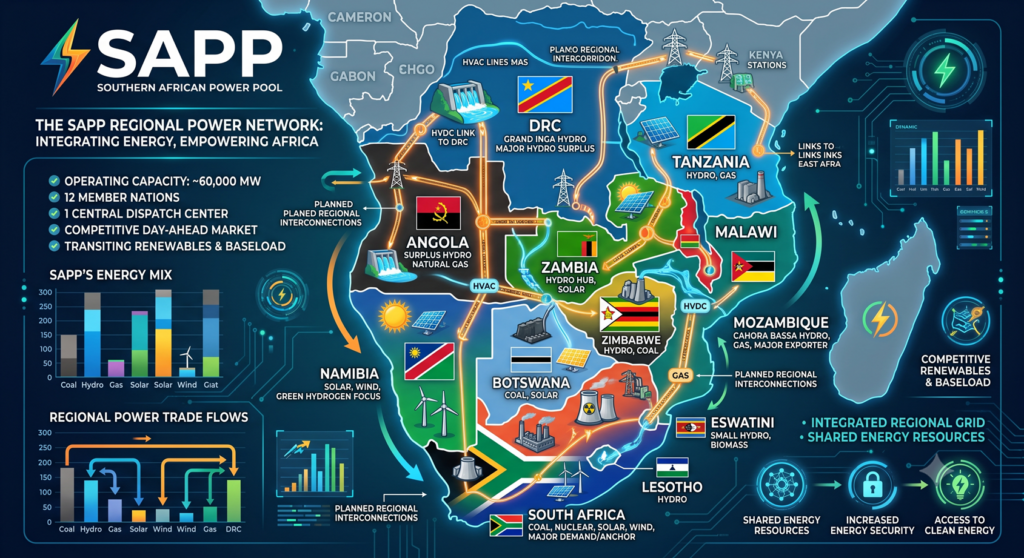
The Southern African Power Pool (SAPP), established in 1995, is widely recognized as the most advanced and structurally integrated regional power pool on the African continent. Serving twelve member nations with an interconnected operating capacity of approximately 48 GW to 60 GW (depending on active generation availability), SAPP acts as a balancing mechanism for a highly diverse landscape of energy resources.
Despite its success in pioneering competitive short-term trading markets, such as the Day-Ahead Market (DAM), the network faces structural limitations that prevent full optimization.
1. Resource Breakdown: Installed, Utilized, and Untapped Potential
The core strength of SAPP is its complementary energy profile. The northern sub-region is heavily dominated by hydro-geography, while the southern sub-region has traditionally relied on thermal coal, now transitioning toward world-class solar and wind resources.
| Country | Key Energy Resources | Installed / Operating Capacity (MW) | Resource Utilization & Regional Contribution | Untapped / “Left Behind” Resources |
| South Africa (Eskom) | Coal, Nuclear, Solar PV, Wind | ~50,700 / ~48,400 | Major Anchor & Consumer: Traditionally supplies baseline power via thermal coal; actively integrating massive private solar/wind to address structural domestic shortfalls. | Tens of gigawatts of world-class solar in the Northern Cape and wind in the Eastern/Western Cape awaiting grid allocation. |
| Angola (RNT) | Hydropower, Natural Gas | ~3,100 / ~2,500 | Self-Sufficient / Isolated: Highly localized utilization; boasts a capacity surplus but has historically faced physical transmission isolation from the core SAPP grid. | Over 15,000 MW of unexploited hydro potential along its river basins, alongside massive associated natural gas reserves. |
| DRC (SNEL) | Mega-Hydropower | ~2,450 / ~1,070 | Exporters of Cheap Hydro: Supplies low-cost baseload power southwards via a long High-Voltage Direct Current (HVDC) line, though domestic grid stability is notoriously poor. | The Grand Inga Cascades: The world’s largest untapped hydro site, with an estimated potential of 40,000 MW left entirely undeveloped due to financing and political hurdles. |
| Zambia (ZESCO) | Hydropower, Solar | ~2,730 / ~2,730 | Hydro Hub: Vital central transit corridor. Contributes significant hydro power but is highly vulnerable to climate-induced droughts. | Extensive run-of-river hydro sites and scalable utility-scale solar across its flat, high-irradiation plains. |
| Mozambique (EDM/HCB) | Hydropower, Natural Gas, Coal | ~2,720 / ~2,280 | Net Exporter: The Cahora Bassa hydro plant (~2,075 MW) is a critical source of clean, cheap contractual power for South Africa and Zimbabwe. | Massive onshore/offshore liquefied natural gas (LNG) fields in the Rovuma Basin and the planned 1,500 MW Mphanda Nkuwa downstream hydro project. |
| Zimbabwe (ZESA) | Coal, Hydropower | ~2,045 / ~1,550 | Net Importer / Transit Hub: Suffers from severe domestic shortfalls due to aging thermal assets at Hwange and low water levels at Kariba; relies on SAPP imports. | Substantial coal-bed methane (CBM) reserves, solar potential, and underdeveloped run-of-river hydro. |
| Botswana (BPC) | Coal, Solar | ~920 / ~460 | Deficit Mitigation: Relies heavily on coal generation (Morupule) but frequently experiences plant underperformance, requiring balancing imports from SAPP. | Immense coal reserves (over 200 billion tons) that face environmental funding locks; exceptional solar PV conditions. |
| Namibia (NamPower) | Hydro, Solar, Wind | ~610 / ~390 | Import-Dependent Pioneer: Imports up to 60% of its power through SAPP but has aggressively built out local solar PV networks. | Massive utility-scale wind and solar potential in the Namib Desert, directly tied to emerging green hydrogen initiatives. |
| Tanzania (TANESCO) | Hydro, Gas, Coal | ~1,360 / ~820 | Evolving Partner: Traditionally focused internally; expanding transmission lines to fully stitch East Africa to Southern Africa. | Vast untapped natural gas reserves and over 4,000 MW of hydro potential. |
| Lesotho & Eswatini | Small-scale Hydro, Biomass | ~140 combined | Satellite Importers: Heavily reliant on Eskom and SAPP bilateral contracts for daily balancing. | Small-scale pumped storage and biomass opportunities. |
2. Is the SAPP Network Fully Utilized?
The short answer is no. While SAPP is highly sophisticated in terms of market architecture (it features live competitive bidding, balancing markets, and forward physical structures), it is profoundly constrained by transmission infrastructure gaps.
The Paradox of Wheel and Stall
Data from SAPP trading floors highlights a persistent issue: in competitive day-ahead markets, up to 40% to 50% of successfully matched energy trades cannot be physically delivered due to transmission bottlenecks.
- The Central Corridor Jam: The interconnections cutting through Zimbabwe, Zambia, and Botswana are frequently congested. If the DRC or Mozambique has excess power to sell to South Africa or Namibia, the physical copper wires running through the central corridor often lack the thermal capacity to “wheel” (transit) that power.
- The “Wheeling” Revenue Problem: Because vertically integrated state utilities control national grids, private power developers face restrictive regulations when trying to wheel power across national borders.
- The Drought Vulnerability Effect: Because SAPP relies heavily on a handful of massive hydro assets (Kariba on the Zambezi, Cahora Bassa), regional droughts drastically lower regional operating capacity, forcing nations back onto carbon-heavy thermal fallback options.
3. Pathways to Improvement: A Blueprint for Optimization
To unlock the massive amounts of “left behind” energy across Southern Africa, SAPP must shift its focus from building generation assets to reinforcing transmission grids.
Strategic Solutions
- Deploy Regional Energy Storage Strategies: SAPP is actively coordinating regional battery energy storage systems (BESS) and pumped hydro storage framework investment plans. Integrating grid-scale batteries at critical cross-border substations stabilizes the grid, allowing highly variable solar and wind power to be traded smoothly across time zones.
- Capitalize via the Regional Transmission Infrastructure Fund (RTIFF): Traditional state utilities are too debt-burdened to build cross-border interconnectors. SAPP’s market-driven funding vehicles must be leveraged to de-risk transmission investments, allowing private capital to fund lines and recoup investments directly from wheeling tariff revenues.
- Fast-Track Open Access Grid Reforms: Member nations must follow the regulatory leads of countries like South Africa and Zimbabwe, which have begun relaxing state monopolies by allowing independent power producers (IPPs) to sell directly to cross-border off-takers.
4. Cross-Border Symbiosis: Member vs. Non-Member Benefits
The ultimate value of SAPP lies in its geography. It sits perfectly positioned between isolated energy ecosystems and the rapidly expanding East African Power Pool (EAPP).
[East African Power Pool (EAPP)]: Tanzania Interconnector [Southern African Power Pool (SAPP)]
How Members and Non-Members Win Together
- The SAPP-EAPP Bridge (The Tanzania Link): The ongoing high-voltage interconnection between Tanzania (SAPP) and Kenya (EAPP) bridges two distinct weather patterns. When East Africa experiences heavy rainfall and excess hydro power, it can wheel that energy south to mitigate droughts in the Zambezi basin, creating a resilient, continent-wide energy balancing loop.
- Integrating Non-Member Isolated Microgrids: Remote mining operations, agricultural clusters, and isolated coastal areas in countries like Mozambique, Angola, and parts of the DRC operate on expensive, carbon-intensive diesel generators. By extending SAPP spurs to these non-grid industrial users, operators get access to cheaper, cleaner regional pool power, while the pool gains premium, dollar-paying customers to fund further grid expansions.
- Resource Optimization via Industrial Swaps: Industrial economies with high energy demands but limited clean generation real estate (like Botswana or South Africa) can enter into long-term capital-sharing contracts to build massive solar installations in neighboring desert climates (like Namibia), wheeling the clean energy home via SAPP infrastructure.
By transforming cross-border transmission lines into viable, revenue-generating infrastructure assets, SAPP can transition from a network constrained by its bottlenecks into a highly optimized, fully integrated energy ecosystem.
Sources:
- Southern African Power Pool (Official Website) https://www.sapp.co.zw
- SAPP Annual Reports https://www.sapp.co.zw/publications
- SAPP Coordination Centre https://www.sapp.co.zw/about-us
- SADC Energy Division https://www.sadc.int
- SADC Regional Infrastructure Development Master Plan (RIDMP) https://www.sadc.int
- World Bank – Southern African Power Pool Projects https://www.worldbank.org/en/topic/energy
- World Bank – Regional Integration through Power Trade https://www.worldbank.org/en/topic/energy/publication
- World Bank – Project Appraisal Document for the Southern Africa Power Market Program https://documents.worldbank.org
- African Development Bank – Energy https://www.afdb.org/en/topics-and-sectors/sectors/energy
- Programme for Infrastructure Development in Africa (PIDA) https://www.afdb.org
- IEA – Africa Energy Outlook https://www.iea.org/reports/africa-energy-outlook
- IEA – Electricity https://www.iea.org/topics/electricity
- IRENA – Planning and Prospects for Renewable Power https://www.irena.org
- IRENA – Africa Energy Transition https://www.irena.org/Regions/Africa
- CIGRE https://www.cigre.org
- IEEE Power & Energy Society https://www.ieee-pes.org
- Energy Policy Journal Electricity Supply and Demand Scenarios for the Southern African Power Pool
https://www.sciencedirect.com/science/article/pii/S0301421516305845 - International Hydropower Association https://www.hydropower.org
- World Bank Hydropower Program https://www.worldbank.org/en/topic/hydropower
- African Union – Programme for Infrastructure Development in Africa (PIDA) https://www.au-pida.org
- African Union Development Agency (AUDA-NEPAD) https://www.nepad.org
Nawaz Ali Lakho is a power-generation professional and project-management consultant with more than 33 years of experience across thermal, nuclear, gas-turbine, steam-turbine, and combined-cycle power plants. His career encompasses plant operations, maintenance, commissioning, troubleshooting, asset management, and the leadership of multidisciplinary teams of more than 200 personnel.
His hands-on experience includes GE Frame 9E and 6FA and Alstom GT13DM gas turbines; Mitsubishi, GE, and Fuji steam turbines; heat-recovery steam generators; supercritical boilers; and major plant-control platforms from GE, ABB, Emerson, and Siemens. He has participated in cold and hot commissioning, major overhauls, hot-gas-path inspections, and combustion inspections at power facilities ranging from 150 MW to 586 MW.
At Global Power News, Nawaz shares field-informed O&M case studies, technical guidance, equipment insights, and analysis of power systems and energy infrastructure. Connect with him on LinkedIn.
International Experience: Have worked around the world specially, Pakistan, Iraq, Saudi Arabia, UAE, Angola, England and Nigeria.
Disclaimer: Articles are developed using internet research, professional field experience, and AI assistance. While every effort is made to ensure accuracy, the content may contain estimates, projections, or assumptions. The author assumes no liability for technical or computational discrepancies.