Ethiopia’s Power Sector: Resources, Generation Adequacy, Untapped Potential and the Opportunity to Become East Africa’s Power Hub
Executive Summary
Ethiopia occupies an unusual position in Africa’s energy landscape. It possesses enormous renewable-energy resources, has built some of the continent’s largest hydropower projects, and already exports electricity to neighboring countries. Yet a large part of its population still lacks adequate electricity access, electricity consumption per person remains low, and transmission and distribution constraints prevent the country from fully utilizing its generating potential.
The commissioning and inauguration of the Grand Ethiopian Renaissance Dam (GERD) represents a major change in this picture. GERD was officially inaugurated on 9 September 2025 and has a generating capacity of approximately 5,150 MW. Ethiopia reported total installed generation capacity of about 7,910 MW in 2025, up from 4,448 MW in 2022.
The central question, however, is not simply whether Ethiopia has enough installed megawatts. The more important questions are:
- Can those plants reliably produce electricity throughout the year?
- Can the transmission system carry the electricity to consumers?
- Can industries and households obtain reliable connections?
- Is Ethiopia sufficiently diversified beyond hydropower?
- Can surplus electricity be commercially exported when domestic demand is lower?
- Can regional interconnections convert Ethiopia’s renewable resources into a long-term export industry?
The answer is that Ethiopia has moved from being primarily generation-constrained toward a situation in which transmission, distribution, access, demand development, financing and regional power trade are increasingly important constraints.
In resource terms, Ethiopia is nowhere near its limit. Hydropower, solar, wind, geothermal and modern biomass resources remain substantially underdeveloped. The country’s long-term opportunity therefore extends far beyond GERD: Ethiopia could become the principal renewable-electricity hub connecting the Horn of Africa, East Africa and eventually parts of Southern Africa.
1. Ethiopia’s Current Power Situation
Ethiopia has historically faced a paradox: it possesses some of Africa’s largest renewable-energy resources but has had comparatively low electricity consumption and incomplete electricity access.
World Bank data show that 55.4% of Ethiopia’s population had access to electricity in 2023. A newer Ethiopian government report states that access reached approximately 63% by 2025, while preliminary findings from the World Bank’s 2025 Multi-Tier Framework survey put Tier 1+ access at about 44%. These figures measure access differently, but all demonstrate that universal, reliable electricity service has not yet been achieved. This distinction is critical. A country can simultaneously have; surplus generating capacity at particular hours, electricity shortages in particular regions, and millions of people without electricity connections.
Generation capacity therefore should not be confused with electricity availability. The World Bank approved a new $400 million IDA-supported electricity-access program in 2025, supplemented by a $24 million Danish grant, designed to bring clean and reliable electricity to nearly six million additional Ethiopians. This demonstrates that Ethiopia’s challenge is increasingly about getting electricity from power plants through the grid and ultimately to consumers, rather than simply constructing generating stations.
2. Has Ethiopia Generated Enough Electricity?
The answer requires separating three concepts:
Installed capacity: The maximum rated output of all generating plants.
Available capacity: The amount actually available after considering maintenance, hydrology, outages and other operational restrictions.
Energy generated: The actual electricity produced over time, normally measured in GWh or TWh.
Ethiopia’s installed capacity increased substantially with GERD. Government reporting indicates installed capacity of approximately 7,910 MW in 2025. GERD alone provides approximately 5,150 MW of capacity. From a purely installed-capacity perspective, Ethiopia therefore has a substantial generation base relative to its presently monetized electricity demand. But saying that Ethiopia now has “too much electricity” would be misleading. Domestic electricity demand can increase enormously as:
- households receive connections;
- industrial parks expand;
- mining develops;
- electric cooking replaces biomass;
- irrigation is electrified;
- electric vehicles become more common;
- railways expand;
- data centers are developed;
- green hydrogen and ammonia projects emerge;
- agricultural processing increases.
Ethiopia therefore needs to pursue domestic electrification and exports simultaneously rather than choosing between them.
3. The Importance of GERD
The Grand Ethiopian Renaissance Dam fundamentally changes Ethiopia’s electricity system. GERD, located on the Blue Nile/Abay River, was officially inaugurated in September 2025. Its approximately 5,150 MW capacity makes it Africa’s largest hydroelectric power project. GERD provides several strategic advantages. First, it substantially increases available renewable generating capacity. Second, its large reservoir provides operational flexibility. Hydropower can respond more rapidly to changes in electricity demand than many conventional baseload technologies. Third, GERD strengthens Ethiopia’s ability to sell electricity regionally. Fourth, the reservoir can complement intermittent renewable sources. Solar generation peaks during daylight hours, while hydroelectric generation can potentially be adjusted around solar and wind production, subject to water-management and system requirements.
This means GERD should not simply be viewed as a giant electricity generator. It can become the balancing backbone of a diversified Ethiopian renewable-energy system.
4. Ethiopia’s Energy Resources
Ethiopia possesses an exceptionally diverse renewable-energy resource base. The principal resources are:
| Energy Resource | Approximate Potential | Present Development |
| Hydropower | ~45,000 MW exploitable | Most developed resource |
| Solar | Excellent, generally 4–6 kWh/m²/day in many assessments | Very lightly developed |
| Wind | Very large resource | Limited development |
| Geothermal | Up to ~10,000 MW in commonly cited estimates | Very lightly developed |
| Biomass | Large agricultural/organic resource | Mostly traditional use |
| Natural gas | ~7 trillion cubic feet reported/certified in Ogaden Basin | Limited commercial development |
The U.S. Department of Commerce estimates Ethiopia’s combined electricity-generation potential from hydro, wind, solar and geothermal resources at more than 60,000 MW. It also reports that seven trillion cubic feet of natural gas reserves in the Ogaden Basin were certified by the government in 2022. More recent Ethiopian investment material illustrates just how large the theoretical resource base could be, reporting around 45 GW of exploitable hydropower and 10 GW of geothermal resources, alongside extremely large technical wind and solar resources. The important conclusion is therefore clear: Ethiopia is utilizing only a fraction of its total energy resources.
5. Hydropower: Ethiopia’s Dominant Resource
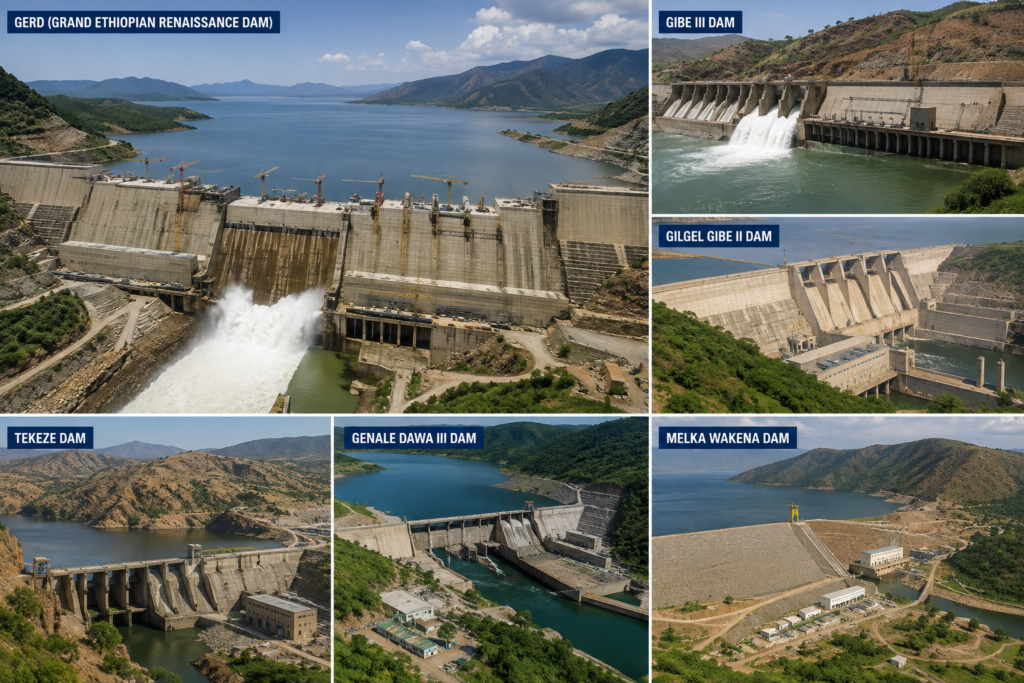
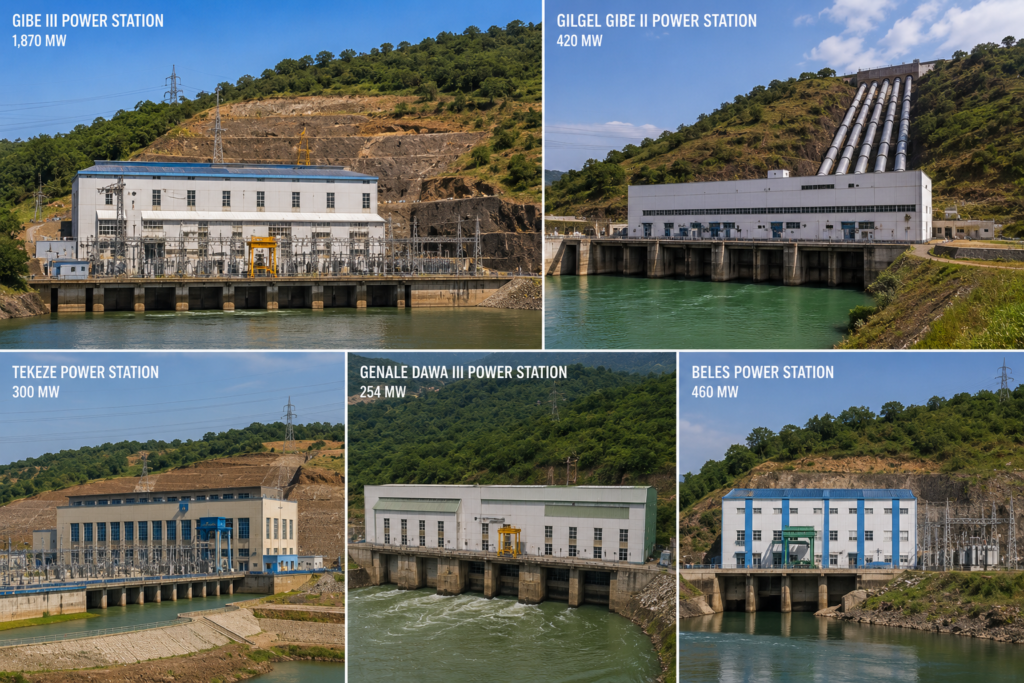
Hydropower currently forms the backbone of Ethiopia’s electricity system. Major plants include:
- GERD
- Gilgel Gibe I
- Gibe II
- Gibe III
- Genale Dawa III
- Tekeze
- Beles
- Melka Wakena
- other medium and smaller hydroelectric projects.
Hydropower has several advantages for Ethiopia:
- indigenous resource;
- no imported fuel requirement;
- relatively low operating cost;
- long plant life;
- low operational carbon emissions;
- potential electricity-export competitiveness;
- ability to support grid balancing.
However, excessive dependence on hydro creates risk. Ethiopian Electric Power has itself highlighted climate variability as a concern, noting that drought conditions can significantly reduce hydroelectric output. Consequently, Ethiopia should not respond to GERD by simply building hydroelectric projects indefinitely. The next stage should be diversification around hydropower.
6. Solar Energy: One of Ethiopia’s Largest Untapped Opportunities
Ethiopia has excellent solar resources across large parts of the country. Yet utility-scale solar remains extremely underdeveloped relative to the resource. Solar is particularly attractive because it can:
- be constructed relatively quickly;
- supply isolated communities through mini-grids;
- support agricultural pumping;
- supply daytime industrial demand;
- reduce pressure on hydro reservoirs during daylight hours;
- complement hydropower seasonally;
- attract private Independent Power Producers.
Ethiopian Electric Power reported that two 225 MW solar IPP auctions were announced in early 2025, while also identifying financing, foreign-exchange and regulatory constraints affecting private investment. Solar-plus-hydropower represents an especially attractive combination. Instead of generating hydroelectricity unnecessarily during sunny daytime hours, solar can serve part of the load while reservoir water is conserved. Hydropower can then increase output during evening peaks. Effectively, Ethiopia’s reservoirs can provide part of the balancing function that battery systems provide in other countries.
7. Wind Energy
Ethiopia also possesses excellent wind corridors. Existing wind projects such as Ashegoda and Adama demonstrated the technical feasibility of wind generation, but development remains small compared with national potential. Wind has particular strategic value because its production pattern may differ from hydropower and solar. A properly planned portfolio consisting of: would be much more resilient than an electricity system dominated almost entirely by hydropower.
Future wind development should therefore be based on detailed resource mapping, transmission availability and competitive procurement rather than simply installing projects wherever good wind resources exist.
8. Geothermal: Potentially Ethiopia’s Most Strategically Valuable Underdeveloped Resource
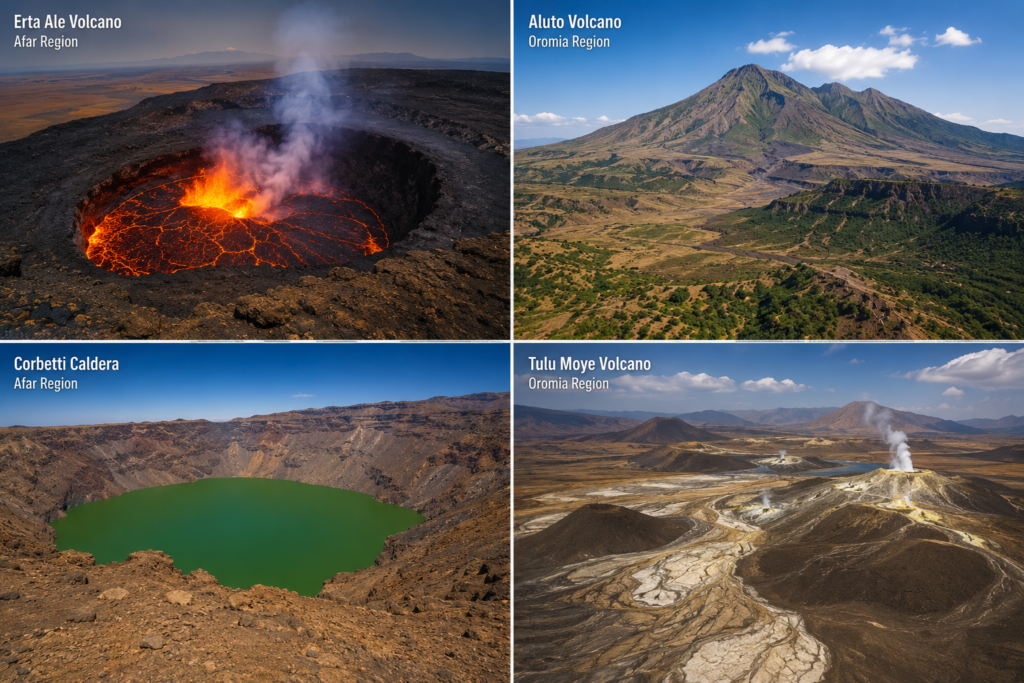
Ethiopia lies along the East African Rift System and possesses significant geothermal potential. Estimates commonly place potential at up to approximately 10,000 MW. Projects and prospects include areas such as:
- Aluto-Langano;
- Corbetti;
- Tulu Moye;
- other Rift Valley geothermal fields.
Geothermal deserves particular attention because unlike solar and wind, geothermal plants can operate continuously. A geothermal plant can therefore provide firm renewable power 24 hours per day, subject to maintenance and reservoir management. For Ethiopia, this makes geothermal extremely valuable as a diversification resource. An ideal future system might use:
- geothermal for firm baseload;
- solar for daytime generation;
- wind where resource conditions are favorable;
- hydropower for bulk generation and flexible balancing.
That combination would dramatically improve Ethiopia’s energy security.
9. Biomass and Waste-to-Energy
Biomass occupies a complicated position in Ethiopia. Traditional fuels, including fuelwood, charcoal, agricultural residues and animal waste, still account for a very large portion of household energy consumption. Ethiopian investment authorities estimate traditional fuels at roughly 87% of overall energy consumption in the referenced energy profile. Traditional biomass consumption creates environmental and health problems, including:
- deforestation;
- indoor air pollution;
- inefficient energy use;
- soil-fertility losses when agricultural residues or dung are burned rather than returned to agricultural systems.
The opportunity is therefore not simply “more biomass.” It is to shift from traditional biomass toward modern bioenergy. Potential technologies include:
- biogas;
- agricultural-waste power plants;
- bagasse cogeneration at sugar mills;
- municipal waste-to-energy;
- biomass pellets;
- industrial combined heat and power.
Even more importantly, Ethiopia could progressively replace traditional cooking fuels with electric cooking powered by renewable electricity. That would create domestic demand for GERD and other renewable projects while reducing pressure on forests.
10. Natural Gas and Fossil Resources
Ethiopia also possesses reported natural-gas resources, particularly in the Ogaden Basin. The U.S. Department of Commerce notes government certification of approximately seven trillion cubic feet of reserves. However, Ethiopia’s comparative electricity advantage lies overwhelmingly in renewables. Natural gas may have strategic applications in:
- fertilizer production;
- industrial feedstock;
- chemicals;
- potentially flexible backup generation.
But constructing a heavily gas-dependent electricity system would undermine one of Ethiopia’s strongest economic advantages: its ability to generate electricity without importing large quantities of fuel.
11. Is Ethiopia Fully Utilizing Its Energy Resources?
No. This is perhaps the clearest conclusion of the analysis. Ethiopia has developed hydropower much more aggressively than its other resources, while solar, wind and geothermal remain comparatively underexploited. Historically cited estimates show:
- hydropower potential around 45,000 MW;
- solar irradiation around 4–6 kWh/m²/day;
- geothermal potential approaching 10,000 MW;
- substantial wind resources.
Therefore Ethiopia’s energy problem should no longer be framed as: “Where can Ethiopia find enough energy?” The better question is: “How can Ethiopia finance, connect, diversify and commercially utilize the enormous energy resources it already possesses?”
12. The Transmission and Distribution Challenge
Generation alone does not create an effective electricity system. Electricity must travel through: Power plant – high-voltage transmission substations – medium-voltage distribution – local transformer – customer. Weakness at any point prevents consumers from benefiting from generating capacity. Ethiopia therefore requires large investments in:
- 500 kV and 400 kV backbone transmission;
- regional substations;
- 230 kV and 132 kV networks;
- distribution reinforcement;
- smart metering;
- grid automation;
- reactive-power compensation;
- system protection;
- SCADA/EMS systems;
- maintenance;
- transmission-loss reduction;
- distribution-loss reduction.
The country’s next electricity investment cycle should consequently allocate significant capital to grid infrastructure rather than concentrating overwhelmingly on new generation.
13. Electricity Access versus Electricity Surplus
One apparent contradiction deserves particular attention. How can Ethiopia export electricity while millions of Ethiopians still lack electricity? Because electricity access is primarily an infrastructure and affordability problem, not simply an aggregate-generation problem. A remote village hundreds of kilometers from a transmission network does not receive electricity merely because GERD produces another megawatt. Extending service requires:
- transmission;
- substations;
- distribution networks;
- transformers;
- meters;
- household connections;
- commercially sustainable tariffs.
In sparsely populated regions, grid extension may be uneconomic. Those locations should increasingly use:
- solar mini-grids;
- battery storage;
- standalone solar home systems;
- hybrid renewable systems.
Ethiopia therefore needs both a national interconnected grid and a strong decentralized-energy sector.
14. Can Ethiopia Export Electricity?
Yes, and it already does. Ethiopia has previously exported electricity to Djibouti and Sudan, and the commissioning of the Ethiopia–Kenya electricity highway created a much larger southern export route. The Ethiopia–Kenya system consists of approximately 1,045–1,065 km of 500 kV HVDC transmission infrastructure with transfer capability of up to 2,000 MW. The system became operational in December 2022. This infrastructure is strategically significant because Kenya is not merely an electricity customer. Kenya can become Ethiopia’s gateway to East Africa.
15. Export Route 1: Ethiopia – Kenya
The Ethiopia-Kenya HVDC link is Ethiopia’s most important large-scale electricity-export corridor. Its approximately 2,000 MW bidirectional transfer capability provides the technical foundation for substantial regional trade. Ethiopia can therefore sell surplus renewable electricity to Kenya when economic and system conditions permit. The benefits include:
For Ethiopia
- foreign-exchange earnings;
- better utilization of generating assets;
- larger market for future renewable projects;
- improved system economics.
For Kenya
- access to competitive renewable electricity;
- diversification of supply;
- improved system balancing;
- reduced dependence on more expensive generation during certain periods.
16. Export Route 2: Ethiopia, Kenya, Tanzania
This is potentially even more important. The World Bank notes that the Eastern Electricity Highway is intended to connect onward toward Tanzania and the Southern African Power Pool. Therefore electricity generated in Ethiopia could ultimately follow:
GERD / Ethiopian Grid
Ethiopia–Kenya HVDC
Kenyan Grid
Kenya–Tanzania Interconnector
Tanzania
Southern African Power Pool
This transforms Ethiopia’s potential electricity market from several neighboring countries into a much larger regional market.
17. Export Route 3: Ethiopia and Djibouti
Ethiopia and Djibouti have traded electricity since the first interconnection entered service in 2011. The original 230 kV connection allowed Djibouti to import up to approximately 60 MW and reduced its reliance on expensive fossil-fuel generation. Electricity trade increased from approximately 155 GWh in 2011 to 532 GWh in 2020. A second Ethiopia–Djibouti interconnection is under development. The project includes a 230 kV double-circuit line between Semera and Nagad, with each circuit rated at around 160 MW. As of 2026, African Development Bank records continue to show implementation activity on the second interconnection. Djibouti therefore represents an attractive long-term electricity customer because imported Ethiopian renewable power can substitute relatively expensive fossil-fuel generation.
18. Export Route 4: Ethiopia – Sudan
Sudan has historically been another customer for Ethiopian electricity. The long-term opportunity remains significant because Ethiopian hydroelectricity could support Sudan’s electricity system and eventually contribute to wider Nile Basin power trading. However, political instability, infrastructure security and payment risks must be incorporated into electricity-export planning. Power exports are commercial contracts; generating capacity alone does not guarantee bankable revenue.
19. Future Export Route: Ethiopia – Somalia
Somalia represents a potentially important future electricity market. Much of Somalia’s electricity supply has historically depended on relatively small and expensive local generation systems. Regional transmission could eventually allow Ethiopian renewable electricity to replace part of that generation. The World Bank’s RETRADE-EA program, approved in June 2026 as part of a $1.6 billion regional financing package, explicitly aims to strengthen Eastern African electricity integration and includes efforts to integrate countries such as Somalia into regional networks. This creates a significant long-term opportunity for Ethiopia.
20. The Eastern Africa Power Pool
The most important development may ultimately be the creation of a functioning regional electricity market rather than individual bilateral export agreements. The Eastern Africa Power Pool (EAPP) can allow electricity to be bought and sold across interconnected national systems. The World Bank’s 2026 RETRADE-EA initiative is supporting infrastructure and institutional development and plans to support an EAPP Day-Ahead Market. This matters enormously. Instead of Ethiopia signing only long-term bilateral contracts, Ethiopian Electric Power could eventually participate in a regional market where electricity prices change according to:
- time of day;
- available generation;
- hydrology;
- regional demand;
- transmission congestion;
- renewable output.
Ethiopia could then sell electricity when regional prices are attractive and conserve reservoir water or serve domestic loads at other times.
21. Ethiopia Could Become East Africa’s “Renewable Battery”
There is a particularly interesting long-term role for GERD and Ethiopia’s other reservoirs. Suppose East Africa eventually develops tens of gigawatts of solar and wind generation. At midday, Kenya, Tanzania, Ethiopia and neighboring countries might have abundant solar electricity. At sunset, solar production falls rapidly while demand remains high. Flexible Ethiopian hydropower could potentially increase generation during these high-value hours. Conversely, when regional solar and wind generation is abundant, Ethiopia could reduce hydro generation and conserve water. Thus Ethiopia could provide not merely electricity, but also:
- balancing services;
- reserve capacity;
- peak power;
- frequency support;
- regional energy security.
These services may eventually be more valuable than simply selling constant blocks of electricity.
22. Electricity Export Economics
Exporting electricity can become an important source of foreign currency. Historical assessments demonstrated the scale of the opportunity. Earlier World Bank projections envisioned substantial growth in Ethiopian electricity exports as regional interconnections expanded. The actual trajectory has developed more slowly than some earlier forecasts, illustrating an important lesson: generation projects can be completed faster than regional electricity markets, transmission infrastructure and commercial arrangements mature. Future export strategies therefore require:
- bankable Power Purchase Agreements;
- creditworthy buyers;
- payment guarantees;
- internationally accepted arbitration arrangements;
- reliable cross-border transmission;
- transparent tariffs;
- regional system-operation rules;
- foreign-exchange settlement mechanisms.
Without these elements, theoretical export potential cannot become reliable export revenue.
23. Domestic Opportunities Created by Abundant Electricity
Exporting power should not be Ethiopia’s only strategy. In many cases, using electricity domestically to manufacture products may create greater economic value. For example:
Electricity – industrial production – exports, may generate more jobs and foreign exchange than:
Electricity: direct electricity export, Potential electricity-intensive opportunities include:
Green fertilizer: Renewable electricity can produce hydrogen through electrolysis. Hydrogen + nitrogen can then produce ammonia and fertilizer. Ethiopia currently has a large agricultural economy, making domestic fertilizer production strategically attractive.
Green hydrogen: Very low-cost renewable electricity could eventually support hydrogen production for domestic industry or export.
Data centers: Reliable renewable electricity and suitable telecommunications infrastructure could attract data centers and digital infrastructure.
Mining and mineral processing: Instead of exporting raw minerals, Ethiopia could use low-cost electricity for domestic processing.
Electric transport: Electrifying vehicles, buses, railways and freight systems reduces petroleum imports.
Electric cooking: Replacing charcoal and firewood with electricity could simultaneously increase productive use of GERD electricity and reduce deforestation.
Irrigation: Electric pumps can expand agricultural productivity while replacing diesel pumping.
Industrial parks: Reliable electricity can make Ethiopian manufacturing more competitive.
24. Major Investment Opportunities
The Ethiopian electricity sector therefore presents opportunities across an entire value chain rather than merely power-plant construction. Major opportunities include:
- Utility-scale solar farms.
- Wind farms.
- Geothermal exploration and generation.
- Small and medium hydropower.
- Battery energy-storage systems.
- Transmission lines.
- High-voltage substations.
- Distribution-network rehabilitation.
- Smart meters.
- SCADA and digital grid management.
- Mini-grids.
- Solar home systems.
- Electric-vehicle charging.
- Electric cooking.
- Industrial electrification.
- Green hydrogen and ammonia.
- Regional interconnectors.
- Power-trading platforms.
- Grid consulting and engineering.
- Operations and maintenance services.
The sector therefore offers opportunities for:
- Independent Power Producers;
- EPC contractors;
- equipment manufacturers;
- transmission developers;
- international utilities;
- development-finance institutions;
- infrastructure funds;
- sovereign investors;
- private-equity investors.
25. Challenges and Risks
Ethiopia nevertheless faces significant constraints.
Financing: Power infrastructure is capital intensive, while Ethiopia has faced foreign-exchange constraints and limited availability of long-term financing.
Utility financial health: Electricity tariffs must balance affordability against the requirement that utilities recover sufficient revenue to maintain and expand infrastructure.
Currency risk: Renewable-energy developers often borrow in dollars or euros while electricity revenues are denominated in Ethiopian birr. This creates substantial currency risk.
Transmission bottlenecks: New generation cannot deliver its full economic benefit if transmission capacity is inadequate.
Hydrological and climate risk: Heavy dependence on hydropower exposes the system to drought and changing rainfall patterns.
Private-sector framework: Investors require transparent procurement, credible PPAs, predictable regulation and reliable currency-conversion arrangements.
Regional political risk: Cross-border electricity projects depend on political cooperation between several governments.
Domestic demand risk: Large generation projects must be matched by industrial, commercial and household demand or export markets.
26. What Should Ethiopia Do Next?
A rational long-term strategy could be structured around ten priorities.
1. Fully optimize GERD: GERD should operate not simply as a bulk generator but increasingly as a flexible system-balancing asset.
2. Accelerate solar development: Several gigawatts of utility-scale solar could complement Ethiopia’s reservoirs.
3. Develop geothermal aggressively: Geothermal can provide firm renewable power and reduce dependence on rainfall.
4. Expand wind selectively: Wind projects should be located where both resource quality and transmission access are strong.
5. Invest heavily in transmission: The grid must catch up with generation.
6. Modernize distribution: Reducing outages and technical/commercial losses can sometimes deliver electricity more cheaply than constructing additional generating capacity.
7. Electrify domestic energy demand: Transport, cooking, irrigation and industry should progressively shift toward domestically generated electricity.
8. Expand regional interconnections: Priority corridors include:
Ethiopia-Kenya, Ethiopia-Djibouti, Ethiopia-Sudan, and eventually connections facilitating trade toward Somalia, Tanzania and Southern Africa.
9. Build a professional electricity-trading capability: EEP should increasingly think like a regional electricity trader as well as a generation and transmission utility.
10. Attract private capital: Solar, wind, geothermal, storage and selected transmission investments can increasingly be developed using private capital under properly structured regulatory arrangements.
27. Is Ethiopia Likely to Have Surplus Electricity?
At particular times, increasingly yes. But “surplus” should be understood dynamically. Electricity demand changes hour by hour and season by season. Ethiopia might have surplus hydroelectricity during periods of strong reservoir availability while experiencing transmission congestion somewhere else. Future solar deployment could produce midday surpluses. Industrial expansion could absorb those surpluses several years later. Therefore Ethiopia should not simply calculate:
Installed Capacity: Peak Demand = Electricity Available for Export.
Instead it requires detailed hourly production-cost and dispatch modelling incorporating:
- reservoir levels;
- hydrological forecasts;
- solar output;
- wind forecasts;
- geothermal availability;
- domestic load;
- transmission constraints;
- export prices;
- neighboring-country demand.
That modelling should determine when electricity should be consumed domestically, exported or conserved as stored reservoir water.
28. A Possible Future Ethiopian Power System
A well-designed Ethiopian electricity system in the 2030s could potentially look very different from today’s system. It could contain:
Large Hydropower: GERD and other reservoirs supplying bulk electricity and flexibility.
Several GW of Solar: Providing low-cost daytime power.
Several GW of Wind: Diversifying renewable production.
1-3+ GW of Geothermal over time: Providing firm renewable baseload.
Battery Storage: Providing fast-response balancing and grid services.
Strong National Transmission: Connecting generation regions to Addis Ababa, industrial areas and other demand centers.
Regional HV Interconnections: Connecting Ethiopia with Kenya, Djibouti, Sudan and other EAPP countries. The country would then operate not merely as a national power system but as the renewable-energy backbone of Eastern Africa.
29. Overall Assessment
Ethiopia does not fundamentally suffer from a shortage of energy resources. It suffers from a shortage of fully developed, diversified, connected and commercially utilized energy resources. GERD has significantly strengthened the generation side of the equation. Ethiopia’s installed generation capacity reached roughly 7.9 GW in 2025 according to government reporting, and GERD accounts for approximately 5.15 GW of capacity.
At the same time, electricity access remains incomplete, transmission and distribution infrastructure require major investment, and solar, wind and geothermal resources remain far below their potential. Therefore Ethiopia’s next energy transition should move from:
“Build more generating capacity” toward: “Build a diversified electricity economy.”
That means connecting households, powering industry, electrifying transport and cooking, developing solar/wind/geothermal generation, strengthening transmission, and creating a sophisticated regional electricity-export business. The Ethiopia-Kenya HVDC link already provides up to approximately 2,000 MW of transfer capability, while expansion of the Ethiopia-Djibouti interconnection and broader Eastern Africa Power Pool development are opening additional markets.
The World Bank’s June 2026 approval of the ten-year RETRADE-EA regional initiative further strengthens the prospects for cross-border electricity markets, including development of an EAPP Day-Ahead Market and expanded regional interconnections. Consequently, Ethiopia has the potential to become something much larger than an electricity exporter.
It could become the principal renewable-power hub of Eastern Africa, combining hydropower storage and flexibility with enormous future solar, wind and geothermal resources. The decisive challenge is no longer discovering energy. The challenge is converting Ethiopia’s extraordinary natural-energy endowment into reliable electricity, industrial development, universal access and sustainable regional export revenue.
References and Sources
- World Bank: Ethiopia Country Data. Electricity access and development indicators; most recent World Bank access figure shows 55.4% electricity access in 2023.
- World Bank: Accelerating Sustainable and Clean Energy Access Transformation (ASCENT) in Ethiopia, 2025. Details of the $400 million IDA credit, Danish grant and program targeting nearly six million people.
- World Bank: Eastern Africa Electricity Highway. Information on the Ethiopia–Kenya 500 kV HVDC interconnection, approximately 1,065 km route and up-to-2,000 MW bidirectional transfer capability.
- World Bank: Ethiopia–Kenya Electricity Highway Project documentation. Technical information on the approximately 1,045 km HVDC transmission line between Wolayta/Sodo and Suswa and its 2,000 MW design capacity.
- World Bank: Regional Energy Transmission, Trade & Decarbonization Program for Eastern Africa (RETRADE-EA), June 2026. Details of the $1.6 billion regional financing package, EAPP market development and expansion of regional interconnection.
- African Development Bank: Ethiopia-Djibouti Second Power Interconnection Project. Information on the Semera–Nagad 230 kV double-circuit interconnector, power-trade history and project objectives.
- African Development Bank: Djibouti-Ethiopia Power Interconnection. Historical information on the first 230 kV interconnection, including its approximately 60 MW import capability for Djibouti.
- African Development Bank: Ethiopia-Djibouti Second Power Interconnection project records, 2026. Current project implementation documentation.
- Ethiopian Electric Power: Ethiopia’s Energy Crossroads. Discussion of hydropower dependence, GERD, solar development, electricity exports, climate risk and sector diversification.
- Ethiopian Investment Commission: Energy Sector. Information on Ethiopia’s renewable-energy opportunities, electricity consumption, access and traditional-energy dependence.
- U.S. Department of Commerce, International Trade Administration: Ethiopia Energy Country Commercial Guide. Estimates of more than 60 GW renewable-electricity potential, approximately 45 GW hydropower potential, solar resource, geothermal resources and reported natural-gas reserves.
- Ethiopian News Agency: GERD Inauguration, September 2025. Reporting on GERD’s inauguration and generating capacity.
- Reuters: GERD inauguration, September 9, 2025. Independent documentation of the inauguration of the Grand Ethiopian Renaissance Dam.
- Federal Democratic Republic of Ethiopia / UN reporting, 2026. Electricity access and installed generation capacity figures, including approximately 7,910 MW in 2025.
- Invest in Ethiopia 2026 Deal Book. Updated investment information on hydropower, wind, solar and geothermal resources and installed capacities.
- World Bank: Ethiopia Economic Update. Historical analysis of Ethiopian electricity-export potential and regional power-market development.
- African Development Bank: Ethiopia/Djibouti Second Interconnection Appraisal Documentation. Technical and economic information concerning expansion of electricity trade between Ethiopia and Djibouti.

Nawaz Ali Lakho is a power-generation professional and project-management consultant with more than 33 years of experience across thermal, nuclear, gas-turbine, steam-turbine, and combined-cycle power plants. His career encompasses plant operations, maintenance, commissioning, troubleshooting, asset management, and the leadership of multidisciplinary teams of more than 200 personnel.
His hands-on experience includes GE Frame 9E and 6FA and Alstom GT13DM gas turbines; Mitsubishi, GE, and Fuji steam turbines; heat-recovery steam generators; supercritical boilers; and major plant-control platforms from GE, ABB, Emerson, and Siemens. He has participated in cold and hot commissioning, major overhauls, hot-gas-path inspections, and combustion inspections at power facilities ranging from 150 MW to 586 MW.
At Global Power News, Nawaz shares field-informed O&M case studies, technical guidance, equipment insights, and analysis of power systems and energy infrastructure. Connect with him on [LinkedIn](https://www.linkedin.com/in/powerprofessional/).