Unleashing Africa’s Energy Potential: A Strategic Research Report on Underutilized Resources, Investment Barriers, and Mutual Growth Pathways
Africa presents one of the most striking economic paradoxes of the 21st century: it is home to roughly 60% of the world’s best solar potential, vast mineral and natural gas reserves, extensive hydroelectric routes, and immense geothermal tracts, yet it accounts for only a fraction of global energy consumption. Over 600 million people across the continent still lack basic access to electricity.
This research report explores the top resource-rich yet underutilized countries in Africa, analyzes the bottlenecks stalling their development, outlines strategic roadmaps for private investors and country authorities, and demonstrates how symbiotic collaboration can unlock multi-billion-dollar returns.
1. Top African Countries with High Energy Wealth & Low Utilization
While nearly every nation on the continent possesses untapped potential, the following countries stand out for possessing world-class energy reserves alongside critically low exploitation rates relative to their capacity:
| Country | Primary Resource Wealth | Estimated Potential | Current Utilization Status / Bottleneck |
| Democratic Republic of the Congo (DRC) | Hydropower, Solar, Biomass | Inga Dam alone can generate ~42,000 MW; immense solar potential. | Less than 10% national electrification rate; massive potential trapped by civil instability and lack of transmission grids. |
| Ethiopia | Hydropower, Geothermal, Wind, Solar | Over 60,000 MW of hydro and massive geothermal corridors in the Rift Valley. | Highly reliant on seasonal rains; transmission infrastructure is sparse, leaving rural industries starved of dependable power. |
| Angola | Oil, Natural Gas, Solar, Hydropower | Vast hydrocarbon reserves and over 50 GW of combined hydro/solar potential. | Historically over-reliant on oil exports; domestic grid infrastructure fails to reach interior agricultural and manufacturing zones. |
| Nigeria | Natural Gas, Solar, Biomass | World-class natural gas reserves (over 200 trillion cubic feet) and high solar irradiation. | Chronic grid collapses, gas flaring, and pipeline vandalism leave industries dependent on expensive, polluting diesel generators. |
| Kenya | Geothermal, Wind, Solar | ~10,000 MW of Rift Valley geothermal potential; world-class Turkana wind resources. | Despite leading in East Africa, transmission loss and high upfront capital needs limit the scaling of secondary industrial hubs. |
2. Root Causes of Low Energy Utilization
Despite the abundance of natural assets, several structural, financial, and political roadblocks prevent these resources from being converted into usable power:
- Severe Capital Deficit and Sovereign Risk: Africa attracts less than 3% of global energy financing. International investors often perceive high macroeconomic risks, currency depreciation, and potential default threats.
- Weak Transmission and Distribution Grids: Generation capacity means little without infrastructure. Many countries suffer from “grid rot”, outdated, leaky, and centralized transmission lines that cannot handle decentralized or high-volume power inputs.
- Inadequate Regulatory and Policy Frameworks: Bureaucratic red tape, inconsistent tax policies, non-transparent procurement processes, and delayed contract enforcement frustrate foreign direct investors (FDI).
- Insolvent State-Owned Utilities (SOUs): Many national power utilities operate at a financial loss due to heavily subsidized, below-cost tariffs, rampant energy theft, and poor revenue collection, making them unbankable offtakers for independent power producers (IPPs).
- Over-Reliance on Monoculture Energy Systems: Countries often lean entirely on a single source (such as hydropower in East Africa or oil in West Africa), leaving them dangerously vulnerable to climate shocks (droughts) or global commodity price crashes.
3. Strategic Recommendations for Private Investors
To successfully capture high returns while mitigating risk, foreign and domestic private investors should pivot toward the following strategies:
- Embrace Distributed Renewable Energy (DRE) Models: Instead of waiting for massive mega-grids to expand, invest in modular mini-grids, commercial solar-plus-storage solutions, and captive power plants for industrial zones.
- Leverage Blended Finance and Risk Mitigation Instruments: Partner explicitly with multilateral development banks (e.g., Africa Development Bank, World Bank/IFC) to utilize political risk insurance, partial risk guarantees, and first-loss capital layers.
- Form Local Joint Ventures (JVs): Mitigate political pushback and fast-track bureaucratic navigation by partnering with regional firms, indigenous energy companies, and local financial institutions that understand domestic nuances.
- Focus on Value-Chain Integration: Invest not just in power generation, but in localized manufacturing of energy components (e.g., solar assembly, battery storage supply chains), aligning with Africa’s industrialization goals under the African Continental Free Trade Area (AfCFTA).
4. Strategic Recommendations for Country Authorities
For African governments and regulatory bodies to attract long-term capital, structural reforms must be prioritized:
- Strengthen Utility Creditworthiness: Restructure state-owned utilities, introduce transparent tariff adjustments, and digitize metering and billing to guarantee reliable revenue streams for IPPs.
- Streamline Licensing and One-Stop Shops: Create single-window regulatory agencies that fast-track environmental approvals, land acquisition, and tax exemptions for energy developers.
- Expand Regional Power Pools: Foster cross-border energy trade through frameworks like the West African Power Pool (WAPP) or Eastern Africa Power Pool (EAPP), enabling surplus energy to be exported seamlessly to neighboring deficit zones.
- Implement Stable Public-Private Partnership (PPP) Laws: Guarantee clear, legally binding contractual terms with international arbitration clauses to reassure investors that their assets and revenue repatriation rights are legally protected.
5. The Synergy: How Both Parties Benefit
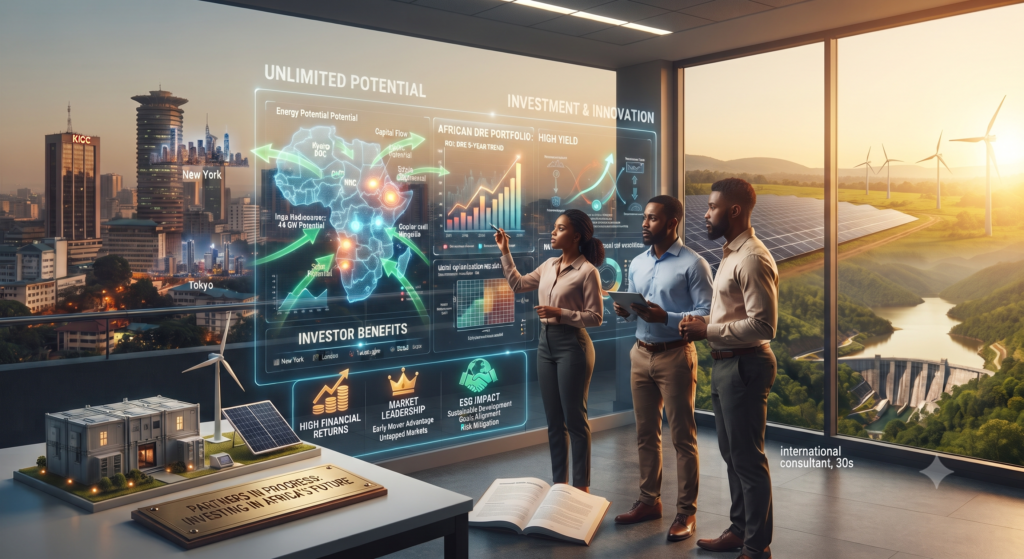
How Investors Benefit:
- High Growth and Untapped Markets: Access to fast-growing populations and unserved industrial sectors with virtually limitless demand.
- Attractive Financial Yields: Early-mover advantage in high-potential green and traditional energy markets often yields higher risk-adjusted returns compared to saturated Western markets.
- ESG Leadership: Substantial contributions to global decarbonization mandates and environmental, social, and governance (ESG) reporting criteria.
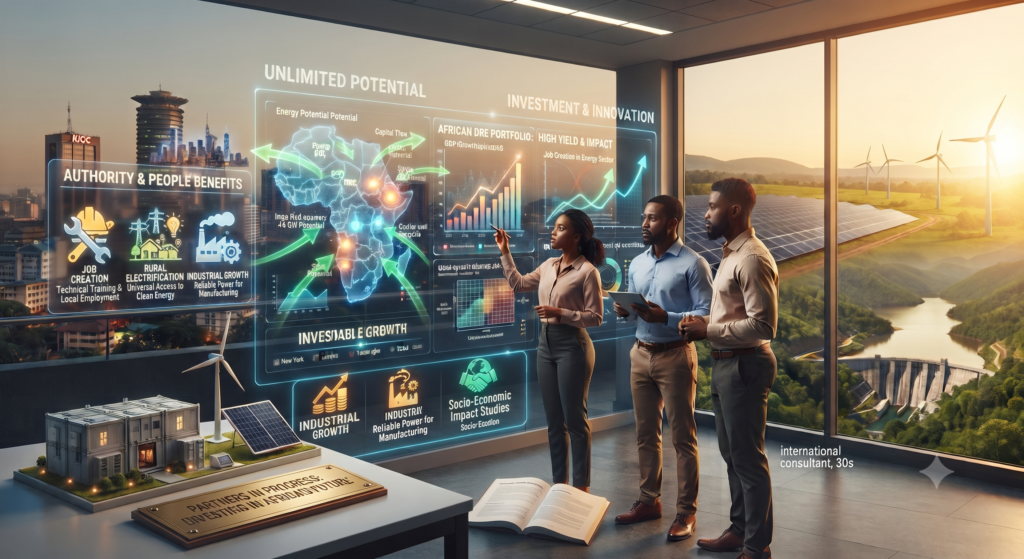
How Country Authorities & Citizens Benefit:
- Job Creation: Scaling the energy sector is projected to generate millions of high-quality local jobs across engineering, construction, and digital management.
- Industrial Transformation: Reliable power fuels local manufacturing, reduces dependency on imported fossil fuels, cuts carbon-related health hazards, and boosts GDP growth.
- Poverty Alleviation: Universal electricity access directly transforms rural healthcare, education, agriculture, and standard of living, fulfilling the targets of the UN Sustainable Development Goals (SDG 7).
Source:
This report draws upon publications and data from international energy institutions, development banks, national regulators and regional power-pool organizations. Figures are presented with their applicable reporting years because energy access, installed capacity and investment levels change over time.
- International Energy Agency – Africa Energy Outlook 2022 Provides analysis of African electricity access, energy demand, infrastructure investment and pathways toward universal energy access.
- IEA – Africa Energy Outlook 2022: Key Findings Supports the statement that Africa contains approximately 60% of the world’s best solar resources while accounting for only a small proportion of installed solar-PV capacity.
- IEA – “A New Energy Pact for Africa” Supports the statement that Africa receives only about 3% of worldwide energy investment. This should be described as total energy investment—not specifically renewable-energy finance.
- IRENA – The Energy Transition in Africa: Opportunities for International Collaboration, 2024 Reports that Africa received less than 2% of global renewable-energy investment over the preceding two decades and examines barriers to financing the continent’s energy transition.
- Tracking SDG7: The Energy Progress Report 2024 Provides internationally harmonized electricity-access data and the methodology used to measure progress toward SDG 7.
- World Bank – DRC Access to Electricity Data Reports national electricity access in the DRC. The latest available value displayed by the World Bank is 22.5% for 2024, so the article’s “less than 10%” claim should be corrected.
- World Bank – DRC Inga 3 Development Program Provides current institutional information about Inga 3, its governance framework and its relationship to energy access and economic development.
- World Bank – Inga 3 Development Program documentation Estimates the total generation potential of the Inga site at approximately 42 GW.
- African Development Bank – Ethiopia Energy Investment Profile Identifies approximately 45 GW of hydropower potential and 10 GW of geothermal potential in Ethiopia.
- World Bank – Angola Electricity Sector Improvement Project Reports estimated renewable-resource potential of approximately 55 GW solar, 18 GW hydro and 3 GW wind.
- Nigerian Upstream Petroleum Regulatory Commission – Annual Petroleum Reserves Position Primary source for Nigeria’s current oil and natural-gas reserve estimates. State the exact reserves figure and the effective date appearing in the NUPRC announcement.
- Kenya Ministry of Energy – Geothermal Energy Estimates Kenya’s geothermal potential at up to 10,000 MW across more than 20 prospect areas in the Kenyan Rift.
- World Bank – Solar Photovoltaic Power Potential by Country Provides a harmonized framework for comparing national solar-PV potential.
- Eastern Africa Power Pool Official source for EAPP membership, regional interconnection, power-market development and cross-border electricity trade.
- EAPP – Regional Power Market Development Supports the recommendation that regional electricity trade can improve competition, resource utilization and supply costs.
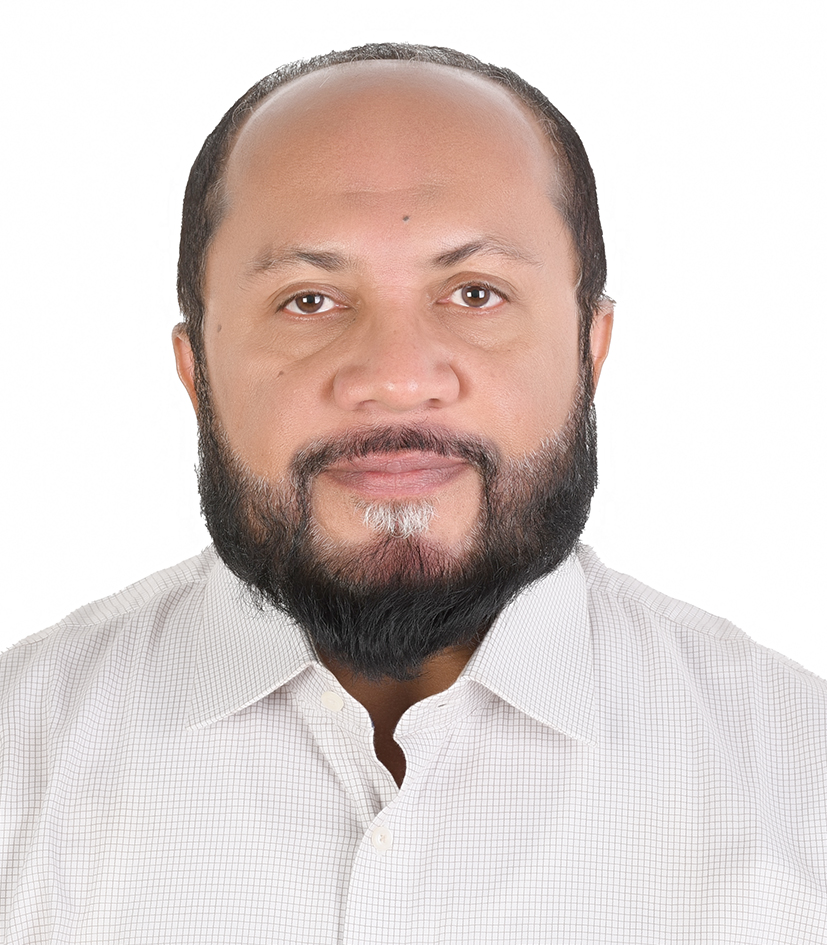
Nawaz Ali Lakho is a power-generation professional and project-management consultant with more than 33 years of experience across thermal, nuclear, gas-turbine, steam-turbine, and combined-cycle power plants. His career encompasses plant operations, maintenance, commissioning, troubleshooting, asset management, and the leadership of multidisciplinary teams of more than 200 personnel.
His hands-on experience includes GE Frame 9E and 6FA and Alstom GT13DM gas turbines; Mitsubishi, GE, and Fuji steam turbines; heat-recovery steam generators; supercritical boilers; and major plant-control platforms from GE, ABB, Emerson, and Siemens. He has participated in cold and hot commissioning, major overhauls, hot-gas-path inspections, and combustion inspections at power facilities ranging from 150 MW to 586 MW.
At Global Power News, Nawaz shares field-informed O&M case studies, technical guidance, equipment insights, and analysis of power systems and energy infrastructure. Connect with him on LinkedIn.
International Experience: Have worked around the world specially, Pakistan, Iraq, Saudi Arabia, UAE, Angola, England and Nigeria.
Disclaimer: Articles are developed using internet research, professional field experience, and AI assistance. While every effort is made to ensure accuracy, the content may contain estimates, projections, or assumptions. The author assumes no liability for technical or computational discrepancies.